


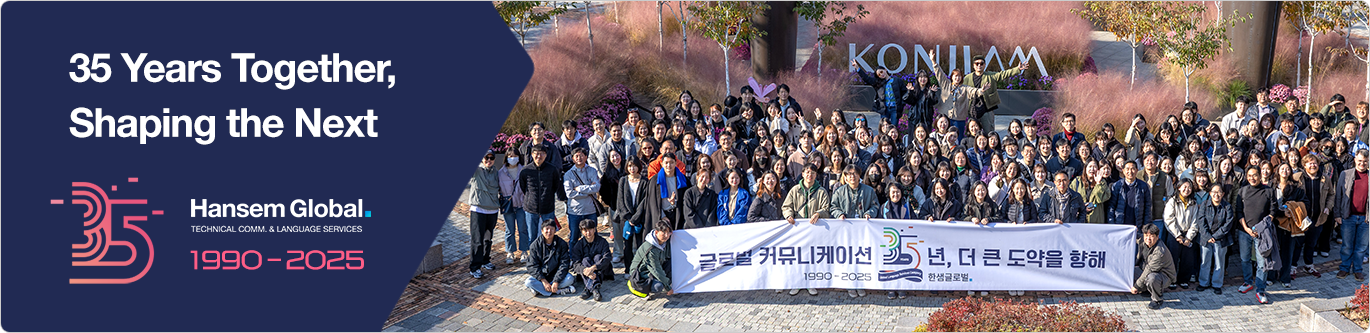
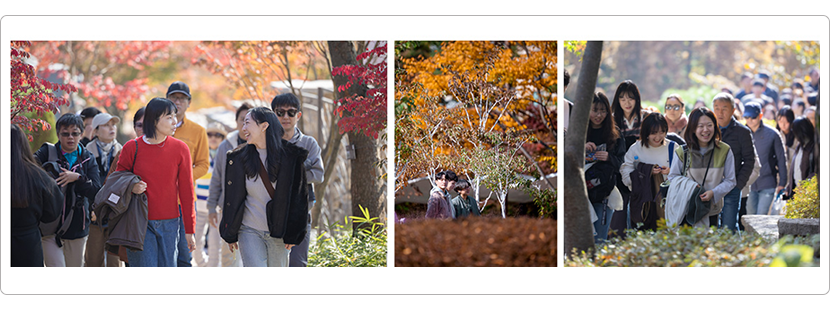
In 2025, Hansem Global celebrates its 35th anniversary. Earlier this fall, our teams from Korea, the United States, and Vietnam gathered at Hwadam Forest near Gwangju, Korea, to mark this milestone together. Stepping away from our desks and walking the forest trails as one global team, we looked back on how far we have come – and, more importantly, how we want to support our customers in the next chapter.
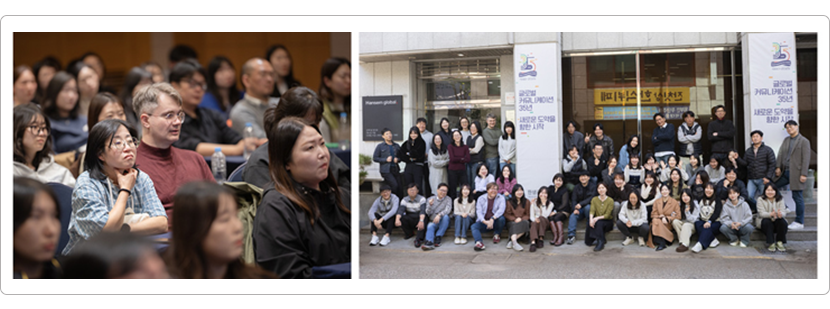
During the ceremony, we divided Hansem Global’s history into four “generations” based on when people joined the company. Colleagues who started in each era – and who are still with us today – shared what the company was like at the time: the work we focused on, the hopes we had, and the results we achieved.
For companies considering a long-term content and localization partner, these four generations say a lot about how we work and how we have learned to scale.
The Trailblazers (1990–2000): Manual craftsmanship as the core engine
The first generation laid the foundation for Hansem Global. Four team members from this era are still with us today.
From the start, our core strength was end-to-end English user manual development driven from Korea. Instead of sending drafts to overseas agencies, we built an in-house team that planned, wrote, and produced manuals directly for export markets – unusual at the time for a company based in a non-English home market.
We owned the entire documentation lifecycle: defining the information structure and section flow, writing the English source content, designing page layouts, creating illustrations and diagrams, and delivering print-ready files under one roof. For many of our customers today, this is where our “one partner, full lifecycle” model began.
Before mature tooling, everything was done manually or with early desktop publishing tools such as QuarkXPress, so every project demanded significant hands-on effort. But the belief that “our manuals will be used worldwide” created a culture that treats quality, safety, and on-time delivery as non-negotiable.
We started with a single Korean maker of digital communication devices and grew alongside them as they became a global brand, producing manuals for fax machines, printers, multifunction devices, wired and cordless phones, pagers, and feature phones. Limited tools never lowered our bar; from day one we held ourselves to global expectations and took end-to-end responsibility for what we shipped. That habit still defines Hansem Global’s operating DNA.
The Builders (2001–2010): From writing to multilingual scale
The second generation expanded Hansem Global from manual creation into full multilingual manual localization. As our customers entered more markets, the number of target languages increased rapidly – from 4 to 16 to 30 and beyond.
To handle this growth, we strengthened a one-stop production model that connected planning, writing, localization, and publishing in a single standardized workflow. The more languages and volume we handled, the more important our standard processes – and our discipline in following them – became as a safety net for quality and schedule.
During the transition from feature phones to smartphones, we proactively redesigned our manual structures and templates. We also relocated our main office from a regional city to the Seoul metropolitan area, strengthening specialization and clearer division of roles across teams.
Many colleagues joined during this period; 28 of them still work with us today. They built much of the operational backbone that supports our current projects.
The Achievers (2011–2020): Systems, standards, and global LSP growth
The third generation marked our shift from a manual-focused company to a full-stack language services provider. Building on our manual production heritage, we expanded into corporate training content, sales enablement materials, and consumer education assets. This included video and graphic-heavy marketing communication services.
We implemented ISO-based quality systems, standardized every production step, and invested in dedicated language services infrastructure. At the same time, we expanded our presence in Vietnam and China and established our U.S. entity to strengthen local support and 24-hour production coverage.
Entering global LSP rankings and securing a top-tier position in the Korean language services market were not marketing goals; they were outcomes of consistent operations. The 65 team members who joined during this era now lead many of our day-to-day projects and processes.
The Pathfinders (2021–2025): The next wave of growth
The fourth generation is our most recent. These colleagues often describe themselves as “on the way from trainees to seasoned professionals.” They are still learning, but they are doing so on top of 35 years of accumulated experience, working side by side with senior specialists from the first three generations.
The 55 people who joined in this period are deeply involved in areas such as multilingual publishing, automated QA, and data-driven operations. They see AI and automation not as a replacement for human expertise, but as tools to extend capacity and improve consistency. Their motto is simple and clear: “Keep Going. Keep Growing.”
Looking back – and looking forward
Across all four generations, some things have changed and some have not. Technologies, tools, and focus areas have evolved, but the core of our work has stayed the same:
- Providing services that genuinely help the market and our customers
- Building expertise that is not easily replaceable
- Taking full responsibility for quality and deadlines
- Working across teams, locations, and time zones to make projects succeed
As we look beyond our 35th year, our commitment is straightforward:
We will continue to help manufacturers bring products to global markets with documentation and language services that make those products safer, easier to use, and easier to support – in every required language.
From Korea, Vietnam, and the United States, four generations of Hansem Global teammates are working together to grow into an even stronger global content and language services partner for the next 35 years.