LLM Training Data Services
Hansem Global develops and evaluates LLM training data, covering SFT, preference (RLHF/DPO), performance, and safety, with expert human input in Asian languages.



Hansem Global develops and evaluates LLM training data, covering SFT, preference (RLHF/DPO), performance, and safety, with expert human input in Asian languages.


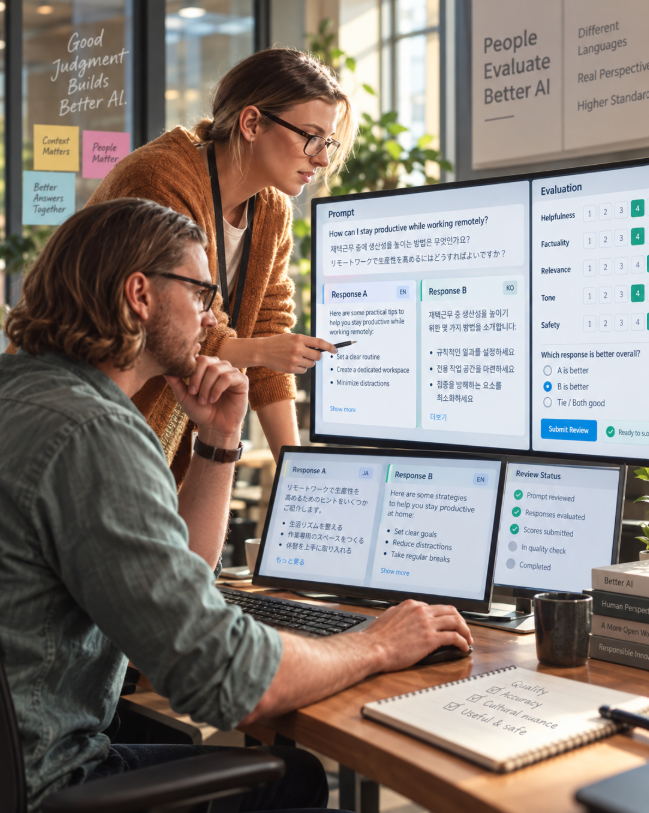
LLM data work requires more than basic annotation. We assign linguists, domain specialists, and trained data reviewers who can assess response quality, instruction following, factuality, relevance, tone, and other project-defined criteria.
SFT, preference data, evaluation, and safety testing are managed as related stages rather than isolated tasks. This helps keep criteria consistent as datasets and model behavior evolve through different development phases.
Our language specialists support multilingual LLM projects with particular strength in Korean, Japanese, Chinese, and Southeast Asian languages. They evaluate not only linguistic accuracy but also naturalness, cultural context, and language-specific response behavior.
Clear rubrics, calibration, multi-stage review, and issue tracking help reduce evaluator inconsistency across large projects. Safety- and policy-related datasets can also be reviewed against client-defined risk categories, privacy requirements, and evaluation criteria.
We build custom prompt–response datasets aligned to your objectives and domain. Coverage includes text tasks such as Open QA, summarization, and reasoning, and prompt engineering for image and video generation models, so the model learns task-appropriate response patterns and logical structure. Backed by multilingual domain experts and ISO-aligned quality controls, we also support multilingual tuning across languages.
Custom prompt–response data for domain tuning

We assess reliability and accuracy using a structured set of quantitative and qualitative metrics. Applying core criteria such as relevance, accuracy, and usefulness, we score model outputs and identify where they fall short. Stage-by-stage A/B tests and competitor benchmarking give data-driven insight to guide model selection and an improvement roadmap.
Model evaluation and A/B testing against clear metrics.
We test the risk factors that undermine trust, including accuracy, factuality, safety, and bias, under conditions close to real production use. Key checks include hallucination detection and response-consistency evaluation. You get practical insight for performance tuning and risk management ahead of enterprise deployment.
Hansem Global?
Built by trainers who understand model behavior.
Our LLM data specialists are more than basic taggers. They work from how models actually behave, studying patterns, responses, and reasoning, to build SFT (instruction) and preference (RLHF/DPO) datasets, calibrating data standards through output analysis rather than fixed rules.
One integrated pipeline.
LLM quality isn't improved in a single pass, so we run SFT, RLHF, and evaluation as one connected workflow. SFT builds generation data, RLHF aligns behavior, and evaluation (benchmarks, human review, scenario tests) checks whether the model is ready for its intended use.
Safety and policy woven into the data.
Our AI-safety-trained specialists work to reduce harmful content, bias, and policy violations, applying policy-guided SFT, safety-focused RLHF, and high-risk scenario testing under strict privacy and de-identification controls to support trustworthy deployment.
We build preference data for RLHF and DPO. By ranking model outputs on human preference, the model learns which response styles are preferred, supporting more natural and consistent answers. We also build scenario-based datasets for single- and multi-turn conversations to train against realistic user interactions.
Human preference ranking for RLHF and DPO.
Case studies, guides, and articles related to this service.

The Secret Behind AI Performance Gaps: High-Density SFT Data

Translators in the Platform Era: How to Work with Freedom and Responsibility
The Core of AI Data Projects: A System for Large-Scale Resource Operations