


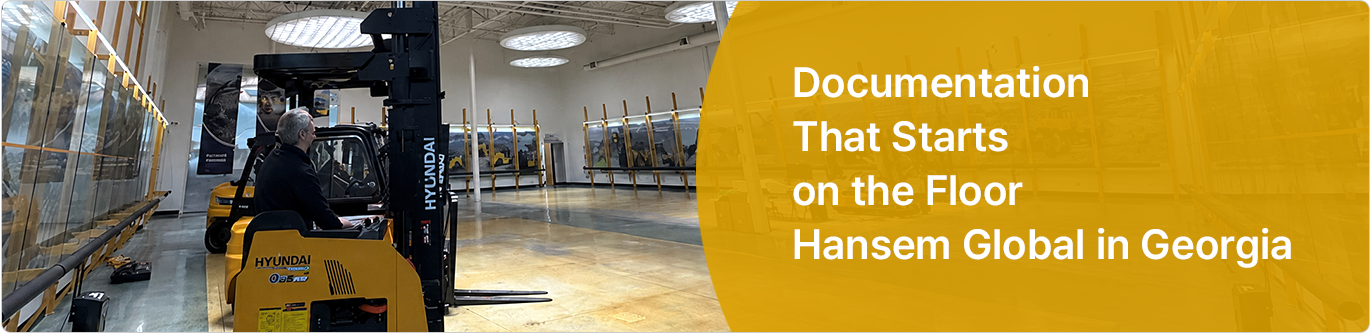
A morning on a forklift maintenance floor in Georgia showed why the best service manuals are designed where the work happens, not at a desk. It was Hansem Global’s first direct engagement with a U.S. operations team, and it confirmed in a new market a principle we have held for more than 35 years.
A Sentence That Stayed With Us
“Right now, the documents are actually getting in the way of the work.”
The site’s lead technical trainer said it with a smile, somewhere between the showroom and the parts area, as if he were sharing an inside joke. He runs technical training at a global forklift manufacturer’s North American operation near Atlanta, and he had just spent the morning walking our team through the site. We saw the showroom, the maintenance bays, the parts and logistics zones, and the training center.
His remark stayed with us long after we left the building. It carried the kind of plain truth that is hard to hear from a desk seven thousand miles away. Documentation that gets in the way of the work it is meant to support. We had flown across the Pacific to hear exactly that.

Why We Were There
A few words about why we were there.
Hansem Global has spent more than 35 years developing technical documentation for some of the most demanding manufacturers in Korea. This trip was a first, though. It marked our first direct engagement with a U.S. operations team and the start of a service manual modernization project for the manufacturer’s North American forklift line.
The team, which we call our U.S. Market Task Force, had landed in Atlanta the day before after fourteen hours in the air. The site sits about an hour from the airport, in a wide-open suburban quiet that felt nothing like the Korean winter we had left behind. We met our hosts that evening over a long, easy dinner full of local character. Most of what matters about schedules and mutual expectations can be talked through over the right meal.
On the Floor
The next morning began the part of the trip that no slide deck can substitute for.

The trainer led us through the site with the easy authority of someone who knows every corner of his operation. The showroom was bright and orderly, with the equipment lined up with care. In the maintenance bays the floors were marked and the tools were where they should be. The air carried that working scent of machine oil and warm metal while technicians moved through the space with the unhurried focus of people who do this every day.
We watched and took notes, and we asked the kinds of questions you can only ask once you have seen the actual workflow. How often do technicians consult the manual, and where? On a tablet, on paper, or on a screen mounted to the truck? When a job is mid-repair and someone needs a torque value, how do they get to it?
These are not questions a documentation team can answer from a brief or a CAD file. They have to be observed.
What Jason Was Saying
That is where the trainer’s comment landed. The existing documents were accurate and thorough, but they were built around the product rather than around the person doing the work. They described what the truck is, not what the technician does. So in the middle of a repair, the manual quietly became one more thing standing between the worker and the finished job.
It is the kind of insight that is almost impossible to fabricate from a desk. You can suspect it, and you can build theories around it. You cannot really know it until you have stood in a maintenance bay and watched a technician hunt for a procedure in real time.
Hypotheses, Sharpened
That afternoon, in the official meeting that followed, we shared what we had been preparing on our end. We walked through the proposed information architecture and the task-oriented restructuring, along with a safety information approach built on the ANSI Z535 and ISO 3864 conventions that North American operations already know. Most of it had been built on hypotheses formed long before the trip. After a morning on the floor, those hypotheses sharpened into something concrete.
By the end of the day, both teams had arrived at something every documentation engagement needs and too often misses. We now held a shared, lived understanding of the working environment. The conclusions were no longer ours or theirs. They belonged to the project.

Where the Answers Live
Documentation is not an attachment to a product. It is part of how the product works in the hands of the person using it. For industrial equipment such as forklifts and lift trucks, where downtime costs money and a wrong move costs more, the manual is part of the operating system.
That is why Hansem Global goes where the equipment is. Not because the trip is romantic, though Georgia in February is honestly pretty nice, but because the answers our customers need are always somewhere on the floor, in the language and habits of the people doing the work. Our job is to listen and observe before we design anything.
Suwon to Atlanta is a long way to fly to listen. Worth every mile.
Frequently Asked Questions
Why does Hansem Global visit customer sites before a documentation project?
Because how technicians actually use a manual, including when, where, and on what device they open it, cannot be learned from a brief or a CAD file. Site observation shapes the information architecture before any writing begins.
What does task-oriented service manual design mean?
It means structuring a manual around what the technician does rather than what the product is, so procedures, torque values, and safety information appear exactly where the work needs them.
Which safety standards apply to service manuals for the North American market?
Service manuals for forklifts and other industrial equipment in North America generally follow ANSI Z535 safety message conventions and ISO 3864 symbol conventions, along with OSHA requirements for the equipment category.
Hansem Global develops user-centered technical documentation for global manufacturers, with deep expertise in service manual modernization, ANSI and ISO compliant safety communication, and on-site information design. To explore how we partner with North American manufacturing teams, visit our Technical Documentation Development services page or reach out to our U.S. Market team.