



For manufacturers shipping products globally, multilingual manuals are not just a documentation task. They are a release-quality risk area. When a manual launches in 10+ languages, even small term mismatches or missing translations can trigger rework, create customer confusion, and add avoidable pressure right before shipment.
At Hansem Global, we produce multilingual manuals across 50+ languages year after year. To keep release timelines stable and reduce late-stage rework, we focus on one principle: high-risk, repetitive checks should not depend on human eyesight alone. They should be systematized.
In this article, we introduce Device Term Guard—a specialized QA tool designed to validate term consistency on one of the most sensitive pages in a user manual: the “Parts Name” section (often labeled “Product Overview” or “Parts Identification”).
Why the “Parts Name” Section Matters
The Parts Name page is one of the first pages users reference when they open a manual. It creates the baseline vocabulary the user will carry into the rest of the document.
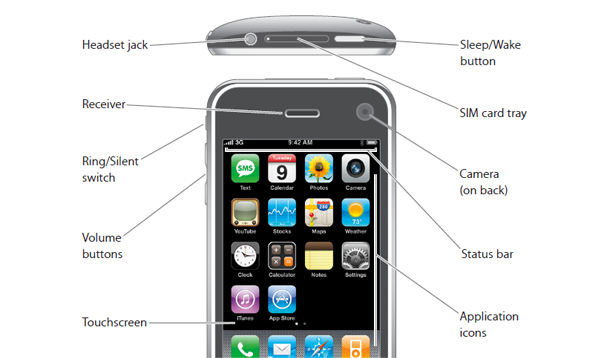
It matters for three reasons:
- It sets the user’s reference point
This section provides the product’s external view, key component names, and a functional overview. If users misunderstand component names here, downstream instructions are harder to follow. - It must stay consistent across the entire manual
Parts terminology is device-specific language. The same terms must be applied correctly in every language and used consistently throughout the manual to avoid confusion. - Late discovery is expensive
A term mismatch is not “just a typo.” It can lead to user misunderstandings, increased support inquiries, and last-minute rework. If discovered right before shipment, fixes often require broad updates across pages and layouts—costly in both time and production effort.
Why Term Consistency Checks Are Hard in Multilingual Manuals
At the final stage of manual production, teams must verify that each language uses the approved terminology correctly. However, a manual visual review has structural limits:
- Complexity increases with every added language
As language count grows, review scope expands rapidly—while release schedules usually do not. - Fonts and unfamiliar scripts increase miss risk
Checking small variations in unfamiliar languages by eye makes it easy to miss subtle but meaningful errors. - Repetition creates fatigue
Parts callouts and repeated labels appear multiple times. The more repetitive the work, the more likely human reviewers are to overlook inconsistencies.
A Practical Answer: Automate High-Risk Term Validation
Hansem Global’s approach is not just to “reduce” term errors, but to structurally prevent them from slipping through by automating the validation step itself.
That is why we built Device Term Guard, one of the QA tools in the Hansem QA Suite.
How Device Term Guard Works
- Extract standard device terms from the source manual
After the source (English or Korean) manual is completed, the tool extracts device terms from technical illustrations where terms are shown as callouts. - Match terms using the manufacturer’s multilingual glossary
The tool pulls language-specific approved terms from the customer’s glossary, creates a project-specific term list, and links it to the target manuals. - Detect mismatches and guide correction
For each language manual, the system flags issues such as:- Missing translation (left in source language)
- Incorrect term usage (not matching the approved glossary term)
- Rule violations (capitalization, symbols, formatting rules)
Reviewers then focus only on the flagged items instead of manually scanning the entire document.
Observed Impact in Production
With Device Term Guard, manual term validation becomes more consistent and less dependent on reviewer fatigue.
In internal projects, we have seen meaningful time reduction compared to fully manual checks, while improving consistency across languages by applying the same rules every time.
Key operational benefits include:
• Shorter term-check cycles
• More predictable quality at the final stage
• Reduced variability across reviewers and languages
• Rule-level consistency (capitalization and symbol rules applied uniformly)
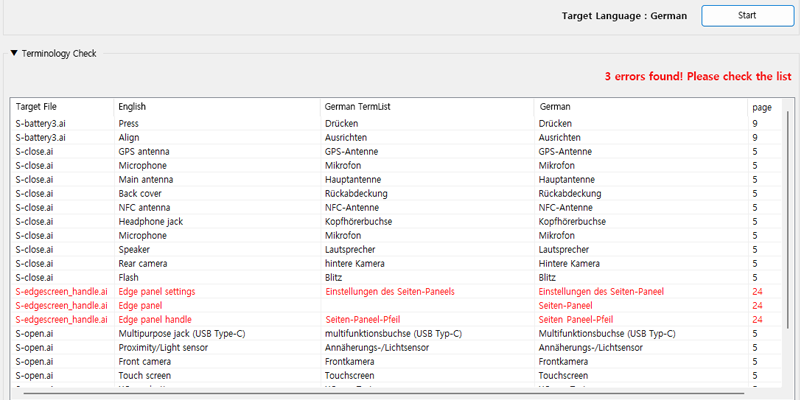
In the above example case, the tool automatically detected multiple German-term issues where the manual did not match the approved term list or contained missing translations.
Technical Content Engineering for Release-Ready Documentation
Device Term Guard is only one tool within the Hansem QA Suite, which includes 60+ QA utilities designed to catch repeatable error patterns across the manual production workflow.
Our goal is simple: identify the most common error scenarios across documentation production and remove them through process design, automation, and measurable verification.
Hansem Global has supported global manufacturers for 35 years, and we continue to invest in scalable content engineering so that multilingual documentation can meet release standards—on time, and with fewer late-stage surprises.
Want to see how term QA automation could fit your workflow?
If you share your product type, languages, and glossary format, we can recommend a practical quality control process optimized for your release environment.