



Developing a Standard High-Voltage Battery Replacement Procedure
As industrial equipment becomes more automated and electrified, manufacturers need service procedures that technicians can follow safely and consistently. A missing isolation step, an unclear lifting condition, or an incomplete acceptance criterion can lead to personal injury, costly equipment damage, increased warranty risk, and inconsistent service results across dealer and field networks. Hansem Global turned fragmented engineering and field information into a controlled, repeatable procedure aligned with recognized international principles for information development and safety communication. The project shows how specialized technical writing can close documentation gaps without placing the full development burden on engineering teams that are already stretched thin.
Technicians should see the hazard and the required preventive action at the moment they need it. That is why safety information was integrated into the task itself.
Project Summary
Hansem Global developed standardized procedures for safely replacing high-voltage battery assemblies on two model families of the manufacturer’s latest industrial equipment.
Challenges
Fragmented and incomplete source data
Critical information was spread across field videos, 3D models, photographs, and presentation slides. No single source contained the complete end-to-end workflow, and the links between tasks, safety controls, and equipment conditions were often missing. Developing the procedure therefore required careful analysis and validation, not simply transcribing the available material.
High-consequence battery service risks
Large high-voltage lithium-ion batteries present electrical shock, fire, thermal-event, and heavy-component handling hazards. If essential controls such as high-voltage shutdown, residual-voltage verification, or secure battery support are omitted, the result can be severe injury, equipment damage, and avoidable exposure for the manufacturer and its service network.
SME bandwidth and validation bottlenecks
The workflow had to be reconstructed by comparing multiple sources, and unresolved details required focused interviews and written questions for the manufacturer’s subject matter experts (SMEs). The goal was to obtain the decisions needed from SMEs without using their time for document assembly, while also placing high-voltage safety information exactly where technicians would need it.
Our Solutions
1. Reconstruct the technical workflow
Simply arranging the supplied materials in sequence would not have produced a usable service procedure. Experienced technical writers compared the sources, reconstructed the actual workflow, and identified the required conditions, technician decisions, and verification points.
Field videos were used to identify technician actions, tools, and disassembly sequences. The 3D models provided information on component geometry, fastener locations, cable interfaces, and surrounding clearances. Photographs and presentation materials filled in details that were not visible in the models. Related technical information and comparable procedures were also reviewed to identify gaps and prepare targeted validation questions.
2. Define entry conditions and completion criteria
Each task included prerequisites, required tools and equipment, machine-state checks, and measurable criteria for moving to the next step. Using the information-development principles of IEC/IEEE 82079-1 and ISO 20607, the team created sequential instructions that support technician decisions rather than providing action statements alone.
Before: Incomplete task information
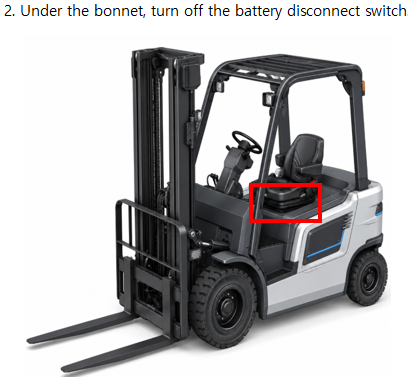
- Only a step number and approximate work location are provided.
- Prerequisites, required tools, and completion criteria are missing.
After: Procedure developed using IEC/IEEE 82079-1 and ISO 20607 principles
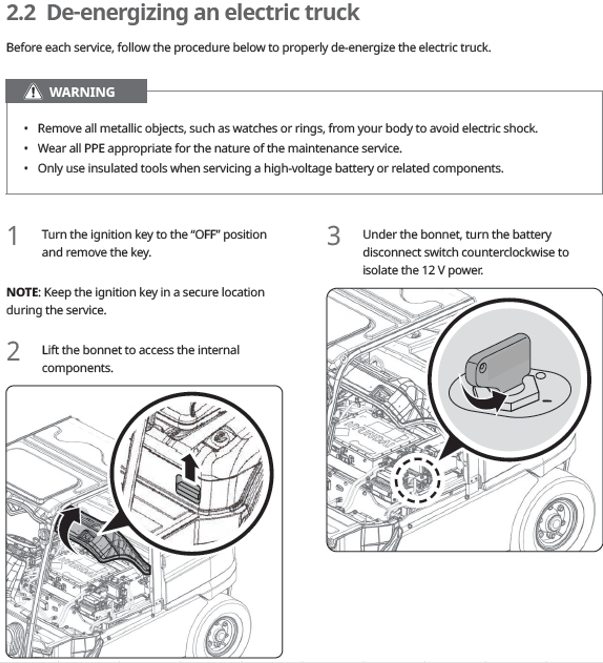
- Critical safety information is placed immediately before the related task.
- The 12 V isolation process is divided into three clear steps with detailed visuals.
Before: Incomplete task information
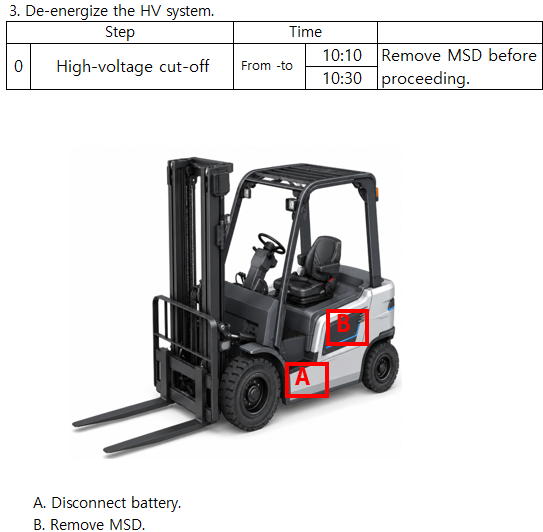
- Detailed instructions for each task are missing.
- Safety-critical MSD removal information is incomplete and buried in a table.
After: Procedure developed using IEC/IEEE 82079-1 and ISO 20607 principles
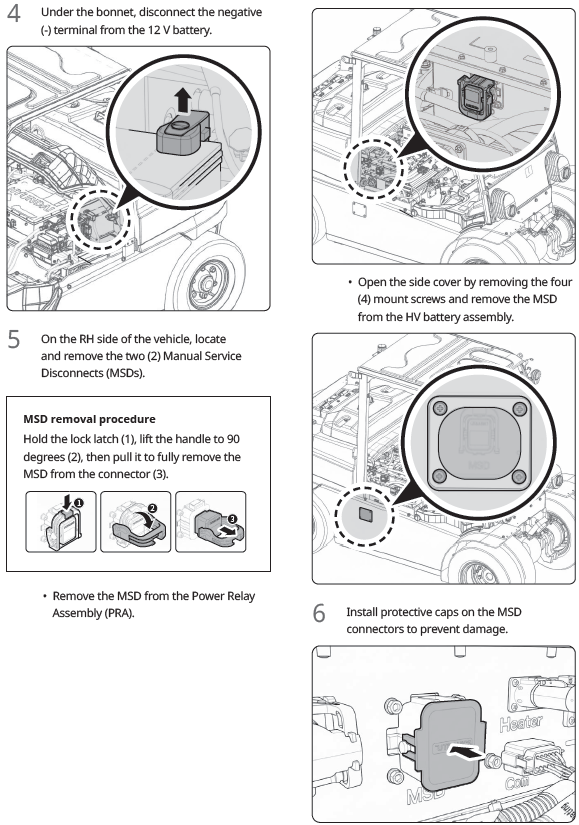
- Sequential instructions cover 12 V terminal disconnection, MSD removal, and protective-cap installation with detailed visuals.
3. Engineer safety communication into the procedure
Hazards were evaluated at the task level, and safety messages were structured using the principles of ANSI Z535.6 and ISO 3864 series. Each message identified the hazard and specified the required controls for high-voltage shutdown, residual-voltage verification, personal protective equipment, battery support and lifting, cable-disconnection sequence, and connection or fastener verification.
Safety information tied to a specific action was integrated into the relevant step or prerequisite. This allowed technicians to see the hazard and the required preventive action when they needed the information, instead of having to rely on a separate safety section.
Before: Incomplete safety information
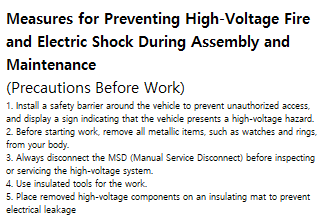
- Safety rules are presented as isolated statements.
- Safety alert symbols and signal words are not applied consistently, making hazard severity difficult to distinguish.
- Safety information is separated from the task and may not be seen when it is needed.
After: Safety-information system based on ANSI Z535.6 and ISO 3864 principles
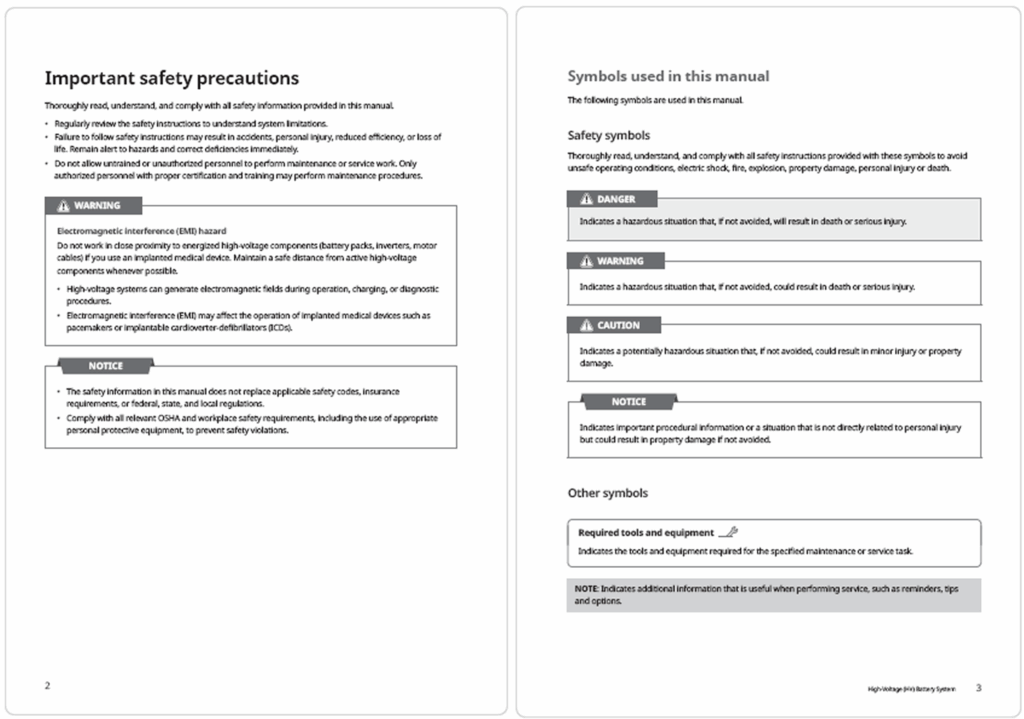
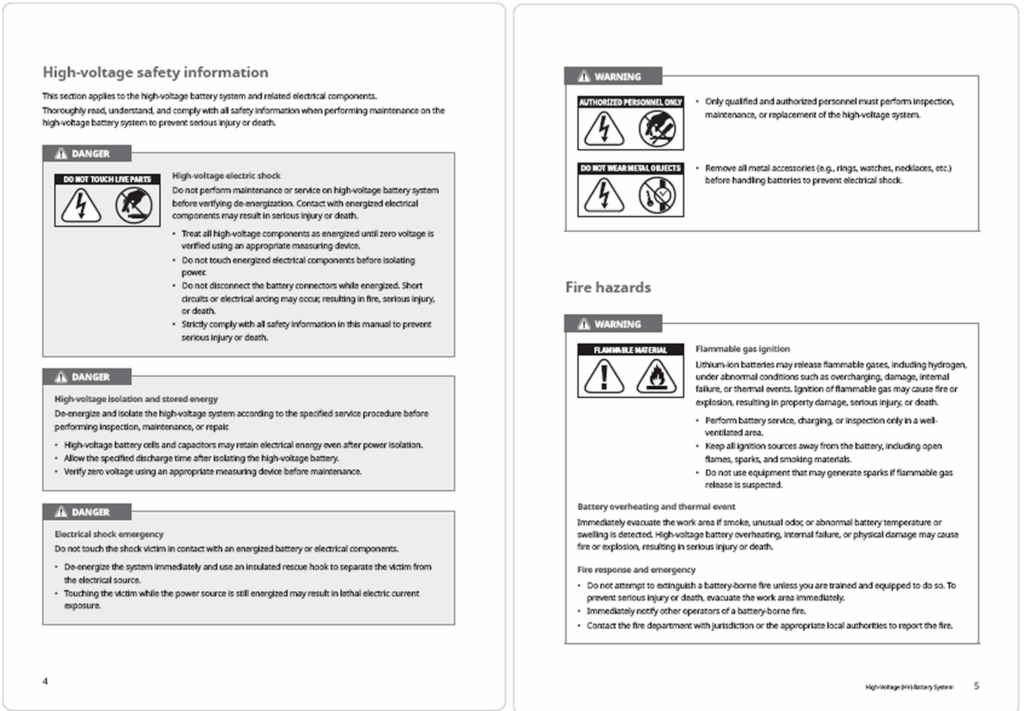
- DANGER, WARNING, and CAUTION indicate personal injury hazards and are presented with safety alert symbols. NOTICE indicates practices not related to physical injury.
- Technicians can quickly recognize message type and hazard severity through consistent formatting and signal words.
After: Safety information integrated into the task
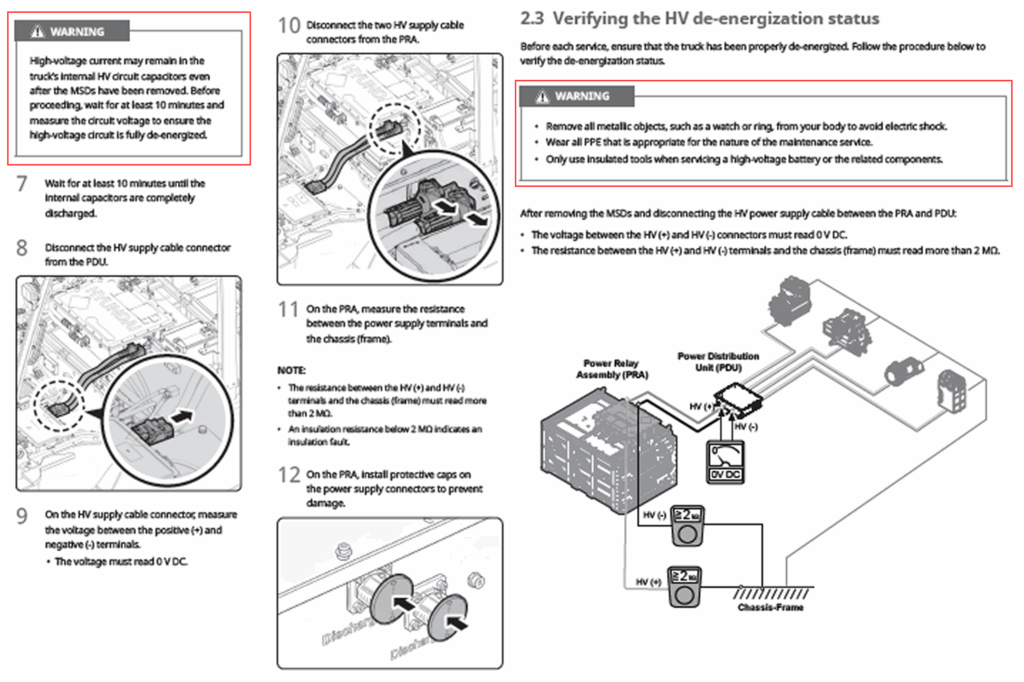
- Residual-voltage warnings and required high-voltage test precautions are placed with the relevant steps so technicians see them when needed.
4. Validate efficiently with manufacturer SMEs
Items that could not be confirmed from the source materials were organized into focused question sets and reviewed through meetings and interviews with manufacturer SMEs. The questions covered task purpose and sequence, high-voltage isolation and residual-voltage checks, tool and lifting-equipment requirements, and fastener or retention criteria.
Confirmed information was incorporated into the procedure, while conflicting or incomplete inputs were sent back for follow-up validation. Through this process, undocumented field knowledge and technician judgment were converted into reusable standard information that can support training, service consistency, future model updates, and controlled revisions.
Outcome
After approximately three months of analysis and validation, Hansem Global completed the standardized high-voltage battery replacement procedures. Technical and safety information that had been scattered across multiple sources, or not documented at all, was brought together in a single executable workflow and finalized through manufacturer SME review.
Manufacturers often face the same constraint: service documentation must be ready for launch even when source data is incomplete, engineering resources are limited, and high-voltage risks leave little room for ambiguity. Hansem Global brings together technical analysis, focused SME collaboration, and safety-information design to produce field-ready procedures. The result is more repeatable service work, better dealer and technician readiness, and a maintainable foundation for future product updates.
Frequently asked questions
- Can a service procedure be developed from videos and 3D models? Yes. Each source provides different information, so the first step is to identify what is available, what is missing, and what requires manufacturer confirmation. In this project, field videos, 3D models, photographs, and slides were compared to reconstruct the workflow, and unresolved points were submitted to SMEs as focused questions.
- Which standards should be considered for high-voltage battery service information? ANSI Z535.6 and ISO 3864 series provide relevant principles for presenting product safety information. IEC/IEEE 82079-1 and ISO 20607 provide principles for developing instructions and machinery information for use. For products supplied in North America, ANSI Z535.6 and the applicable product, workplace, and jurisdictional requirements should be evaluated as part of the manufacturer’s compliance review.
- How do ISO 20607 and IEC/IEEE 82079-1 differ? IEC/IEEE 82079-1 provides general principles and requirements for preparing information for use. ISO 20607 focuses more specifically on instruction handbooks for machinery. For industrial equipment documentation, relevant provisions from both standards can be applied after the product, intended users, and scope have been evaluated.
- Can high-voltage procedures be added to an existing service manual? Yes. The existing manual should first be reviewed to determine whether its safety-message system, terminology, prerequisites, and task structure adequately address high-voltage work. In many cases, updating the surrounding safety framework along with the new procedure results in a more consistent and defensible document.
- Can the same approach be used for electric construction equipment or specialty vehicles? Yes. The same method applies to common risks such as high-voltage isolation, residual-voltage verification, and lifting large, heavy components. However, the equipment architecture, intended service environment, applicable requirements, and manufacturer-specific controls still need to be evaluated for each product.
About Hansem Global
Hansem Global has developed technical documentation and localized it into more than 100 languages since 1990. The company holds ISO 17100, ISO 18587, and ISO 27001 certification, along with ISO 9001 scoped to the manual development process itself. Hansem Global ranked 37th in the 2026 CSA Research Verified 100, an annual ranking of the world’s leading language and global content solutions providers.