




When a new product launches, both consumers and sales teams need a quick way to understand what its new features do and how to use them. Video is increasingly used for this purpose, and short-form video is particularly useful when a single feature or task needs to be explained quickly across product pages, mobile apps, social media, retail channels, and other customer touchpoints.
Generative AI has introduced a new way to produce this type of content by creating characters, environments, and everyday use scenarios without a traditional video shoot. But there is an important difference between creating an AI video for social engagement and producing commercial AI product videos that must accurately represent a real product, its controls, and its user interface.
Hansem Global is currently producing AI-based short-form content for a global consumer electronics manufacturer to introduce new product features. Based on that experience, this article looks at how product information can be turned into short consumer stories—and how AI-generated scenes can be combined with actual product UX to create accurate and engaging short-form product videos.
What Product Content Works Best in Short-Form Video?
Not every product feature needs to be packed into a single video. Short-form content works best when one video focuses on one feature, task, or use case.
For premium home appliances, for example, a water purifier or dispenser could have separate videos for dispensing settings, water temperature, or self-cleaning. A massage chair might feature personalized programs or body scanning. An air purifier could have individual videos for Auto Mode, filter management, or app setup.
The basic structure is simple:
Moment of need → Feature selection and actual operation → Result
The objective is not to explain the technical principles behind the feature. It is to help consumers quickly understand three things:
When would I use this? How do I use it? What changes when I do?
The AI short-form videos Hansem Global currently produces follow this same approach: one feature per video, connected to a short use scenario and the actual product experience.
These feature-focused videos can serve more than one purpose. They can introduce new functions to consumers while also helping retail and sales teams understand and explain them more quickly. The same content can be used on product detail pages, mobile apps, social channels, retail displays, sales training platforms, and customer support channels.
Short-form video is not intended to replace a user manual or detailed product information. Its role is to help consumers and sellers discover and understand a product feature quickly.
AI Short-Form Video Starts with Understanding the Product
Our production process starts by understanding the feature the manufacturer wants to communicate.
When would a consumer need it? What actions need to be taken on the product or in the app? Which parts of the experience must be shown exactly as they appear on the real product?
These questions need to be answered before AI video generation begins.
For consumer-facing product content, simply showing a sequence of operating steps can make the video feel like a condensed tutorial. Showing the moment when the feature becomes useful first makes its value easier to understand.
Consider a camera feature. Instead of opening with the feature name and menu navigation, the video can first show a user in a situation where that feature is needed. It then moves naturally to the actual feature and how it is used.
This is a key principle in Hansem Global’s AI short-form production.
We first understand the product and its function, then turn that information into a situation consumers can recognize. AI is used to visualize that situation.
AI Characters Show the Moment of Need
AI-generated characters can replace live-action talent, but their role goes beyond reducing the need for a traditional shoot. They can act as a consumer persona within the story.
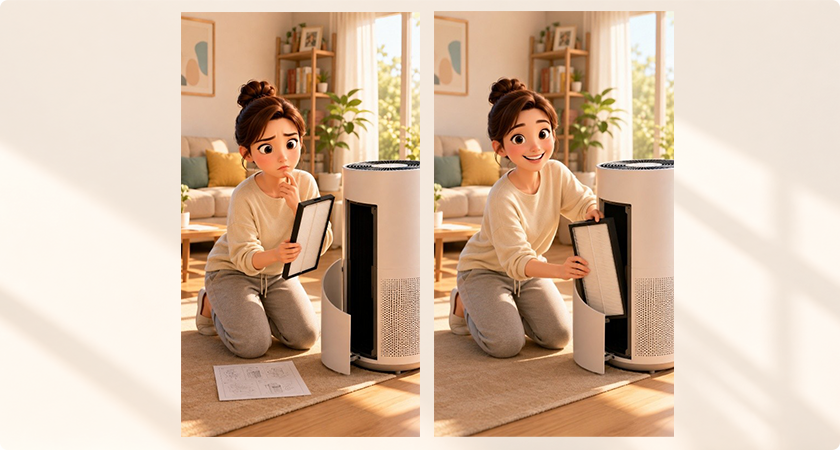
In a short video, it is important to establish very quickly why a feature is being used. A character’s expression, behavior, and surroundings can communicate that context before any detailed explanation begins.
For example, a consumer who sees an unfamiliar filter replacement alert on an air purifier can immediately establish the problem. The video can then move from the consumer’s reaction to the actual product operation and finally to the result.
A simple structure is:
Need → Solution → Benefit
AI characters also make it easier to maintain the same protagonist and visual style across multiple scenes without depending on a particular live-action model. For global product content, the same character and core story can potentially be adapted for different languages and markets.
In other words, AI-generated characters and environments are not simply visual decoration. They help turn a product feature into a short, recognizable consumer story.
Let AI Create the Situation—Not the Product Experience
AI can create the consumer and the environment, but accuracy becomes the priority when the video starts showing how the product actually works.
Smart devices and premium home appliances often combine several interfaces: a product display, physical buttons, a remote control, a touch panel, and a mobile app. Together, these form the actual product UX.
If generative AI is allowed to invent these elements, it can easily produce the wrong screen, button layout, control sequence, or product appearance.
In our current projects, AI-generated usage scenes and actual product screen recordings are created separately and then composited into a single video.
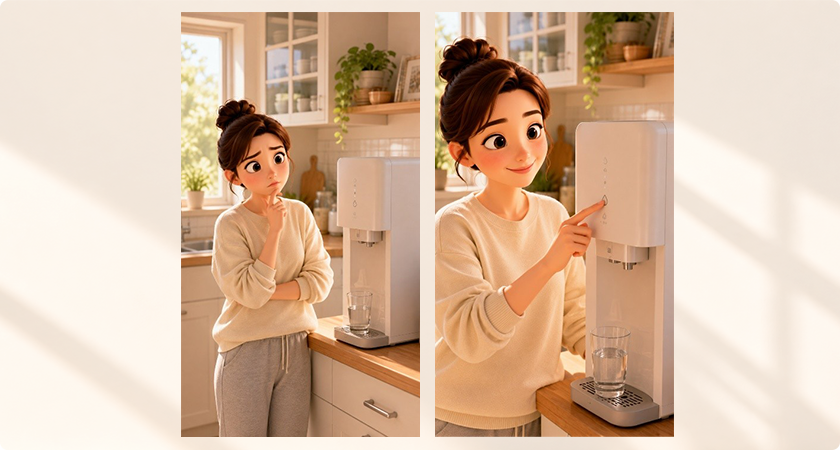
The consumer’s situation and behavior may be AI-generated, while feature selection, settings, and results are shown using the real product and actual UX as the reference.
The production model can be summarized as:
AI-Generated Scene + Actual Product UX + Screen Recording + Compositing
AI provides the flexibility to visualize the consumer story. Actual product information is used wherever feature accuracy matters.
This makes it possible to benefit from generative AI without sacrificing the accuracy expected from commercial product content.
In AI Video Production, Consistency Is Harder Than Generation
Creating a visually appealing AI image or a single short scene has become relatively easy. The challenge begins when multiple scenes have to work together as one video.
The same character may look different when the camera angle changes. Clothing can shift from one scene to another. The color or shape of the product may change. Cameras, buttons, displays, and other recognizable product details can also be altered by the model.
Even when every individual scene looks acceptable, the complete video can feel wrong if the character’s actions, product location, or sequence of use does not connect naturally from one scene to the next.
Revising one scene can create another problem: the regenerated scene may no longer match the scenes before and after it.
This means prompt design cannot focus only on producing the first good-looking image or scene. It needs to account for the entire production sequence.
Before full production, Hansem Global typically spends approximately two to three weeks testing whether the same character remains recognizable across different scenes and angles, whether the product appearance remains consistent, and whether actions and product positions connect naturally. These tests are used to establish the prompt structure for the full project.
For multi-scene generative AI video production, systematic prompt design and continuity control are more important than generating one impressive shot.
AI Short-Form Video Requires a Different QA Process
Revisions also work differently in generative AI video.
In conventional video editing, a subtitle, graphic, or individual cut can often be changed directly. In AI-generated video, changing a character’s facial expression or action may require the entire scene to be regenerated.
If the regenerated character or product looks different, reviewing that scene alone is not enough. The team also needs to check whether it still connects correctly with the scenes around it.
When customer feedback is applied, the production team therefore needs to evaluate not only what needs to change, but also what other parts of the video may be affected.
Key QA points include:
- Character consistency: Does the character remain recognizable across scenes?
- Product accuracy: Do the product shape, color, buttons, displays, and other identifying details match the actual product?
- UX accuracy: Do the screens and operating sequence match the real user experience?
- Scene continuity: Do the character’s actions, product position, and story flow connect naturally?
A visually attractive AI video cannot function as reliable product content if it shows a product or feature incorrectly.
For commercial AI product video production, speed is important, but so is the ability to control product accuracy, UX accuracy, and continuity throughout the production process.
Extending Product Communication Expertise into Video
Producing an AI short-form video involves more than video generation.
The product feature must first be analyzed. A use situation and story must be developed. AI-generated scenes then need to be combined with actual product UX. Editing, voice-over, music, and effects follow, together with checks for product accuracy and overall video quality.
This is where product-focused AI short-form content differs from general visual content production.
Before deciding how a scene should look, the team needs to understand what information must be communicated, what must match the real product, and in what order consumers can understand the feature most easily.
Hansem Global has developed technical documentation and product training content for manufacturers for decades. Technical documentation requires us to understand product functions and operating procedures, then structure that information through text, procedures, graphics, and other formats so users can find and understand what they need.
The underlying approach to AI short-form content is similar.
A user manual explains product information through text and graphics. Short-form video communicates that same type of information through use situations, character behavior, actual UX, and moving images.
Our objective is therefore not simply to generate AI video.
It is to use product communication expertise to turn technical product information into consumer stories and visual experiences that are easier to understand.
Technical Information → Consumer Story → Visual Experience
One Master Video Can Be Extended Across Global Markets
For a global product, production does not necessarily end when the master short-form video is completed. Localization comes next.
Localization may involve much more than translating subtitles. On-screen text, voice-over, product terminology, actual UI, end cards, and market-specific messaging may all need to be adapted for each language and market.
Because Hansem Global works across both product content development and multilingual localization, a single master short-form video can be extended into multiple language and market versions.
The workflow can continue as:
Product Information → Consumer Story → Visual Experience → Global Expansion
A single product can generate multiple feature-specific short-form videos. Those videos can then be localized for use across retail channels, online stores, social media, sales training, and other customer touchpoints worldwide.
AI Can Generate the Video. Product Understanding Still Matters.
Generative AI is rapidly expanding the options available for video production. Characters and environments that once required a live-action shoot can now be generated, making it easier to create multiple feature-focused short-form videos.
But when the purpose of the video is to explain a real product and how it works, attractive visuals alone are not enough.
The production team still needs to decide which feature should become short-form content, identify the right consumer situation, establish the character and story, verify that the actual product and UX are shown correctly, control unwanted AI-generated variations, and make sure the feature can be understood within a short viewing time.
AI short-form product content is therefore not simply an AI production task. It sits at the intersection of product information, consumer experience, storytelling, and video production.
Hansem Global supports this process from product feature analysis and story development through AI short-form production, integration of actual product UX, quality assurance, and multilingual expansion—turning complex product features into short, accurate, and scalable video content for global markets.