




How Hansem Global Developed a Regulation-Ready Heat Pump Manual for Navien
Heat pumps are at the center of Europe's shift to low-carbon heating. In the UK, government incentives are accelerating adoption, and manufacturers entering the market are learning that product performance alone isn't enough. Installers need documentation that covers electrical, plumbing, siting, controls, commissioning, and maintenance in the order they actually do the work, and regulations and international standards define what that documentation must include.
Hansem Global turns manufacturers' technical data into manuals that meet those requirements. The approach holds for any market: start from the rules, then build the manual around the people who use it.
Manufacturers usually have the information. What they need is documentation that meets the market's rules. That's the gap we close.
Project Summary
Navien engaged Hansem Global to develop an Installation & Operation Manual for its air-to-water heat pump line for the UK and Ireland. Working from development-stage drafts and technical data, we built a manual organized around how installers and homeowners actually work with the product.
The line uses R290 refrigerant and spans five models from 4 kW to 17 kW. Each system combines an outdoor unit, a wall-mounted controller, and a Wi-Fi module to provide space heating and domestic hot water. Because it uses a flammable refrigerant and requires both electrical and plumbing work, the manual had to serve installers and end users in a single volume, covering installation requirements, safety, operation, commissioning, and troubleshooting.
Challenges
Meeting the scope the standard requires
IEC/IEEE 82079-1 defines which lifecycle stages product information must cover and how it should be written. A manual has to go beyond installation to include commissioning, operation, maintenance, and troubleshooting. A manufacturer may have every individual piece, but whether those pieces add up to what the standard requires is a separate question.
Safety information for a flammable-refrigerant product
R290 is flammable. Fire and explosion, electric shock, heavy lifting, and corrosion all coexist in one product. Listing hazards isn’t enough. The safety system has to let installers judge severity at a glance and know exactly what to do next.
Local regulations and schemes
Heating appliances sold in Europe are subject to Ecodesign Regulation (EU) 813/2013, which requires product information on precautions for installation and maintenance, and on disassembly, recycling, and disposal. National schemes add another layer. In the UK, the Benchmark scheme requires installation and commissioning records to be handed over to the end user, so the manual must explain the scheme’s purpose, the installer’s obligations, and how to complete the checklist.
Our Solutions
1. Structuring the Manual Around the Real Workflow
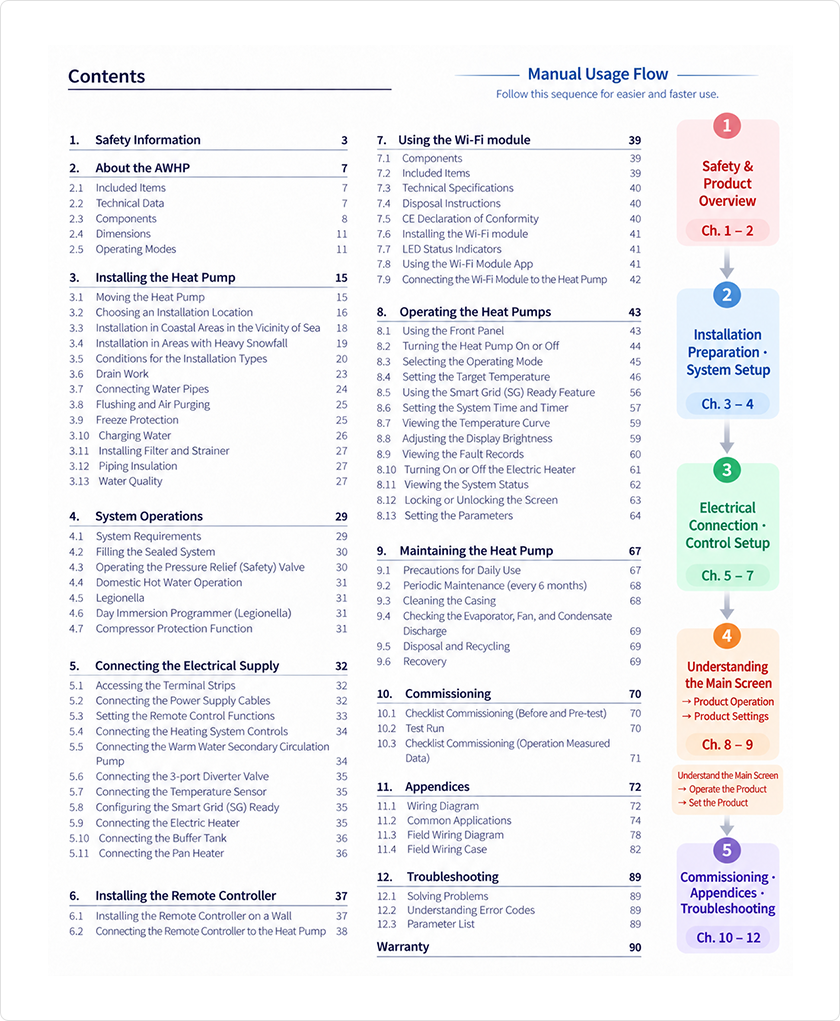
The people reading an installation and operation manual are standing in front of the product. Its structure should follow the order in which they actually handle it, not the way the product’s features are categorized. Drawing on its experience developing boiler and water heater manuals for Navien, Hansem Global made the install–operate–maintain workflow the backbone of the document.
- Chapters in task order — The manual runs from moving the unit and choosing a location through piping, system operating conditions, electrical wiring, controller and Wi-Fi module installation, operation, maintenance, commissioning, and troubleshooting.
- The full scope the standard requires — IEC/IEEE 82079-1 requires commissioning and troubleshooting information as part of the product lifecycle. Each has its own chapter.
- Information grouped by task — Within each chapter, information is organized by task and broken down hierarchically. The installation chapter, for example, has separate sections for moving the unit, siting, coastal areas, heavy-snow areas, condensate drainage, pipe connections, freeze protection, and water quality.
- Built for navigation — The table of contents lists pages down to the section level, every page shows its chapter name and page number, and related requirements are linked by cross-references.
2. Designing a Safety Information System
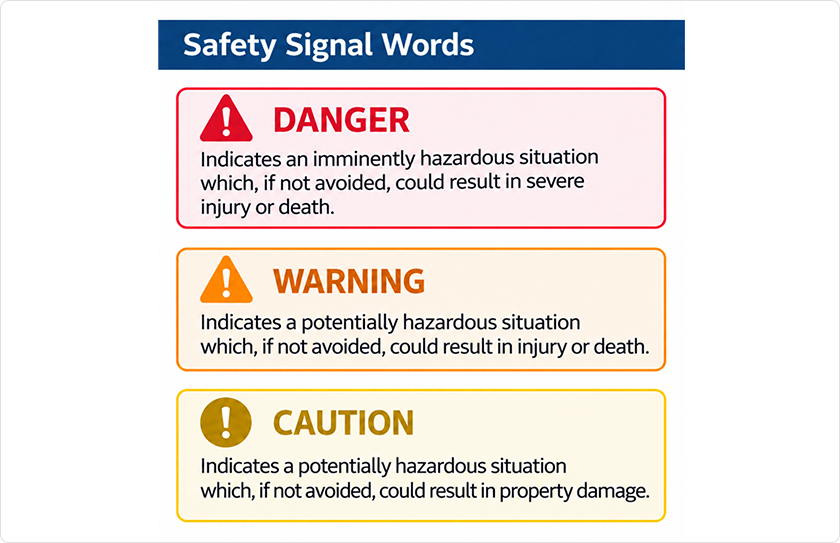
To give installers a safety system they can read at a glance, Hansem Global designed the safety information according to the principles of IEC/IEEE 82079-1 and ANSI Z535.6.
- Clear hazard levels — Hazards are classified into three levels, DANGER, WARNING, and CAUTION, and each level is defined at the front of the manual. Installers can tell how serious a hazard is from the signal word alone.
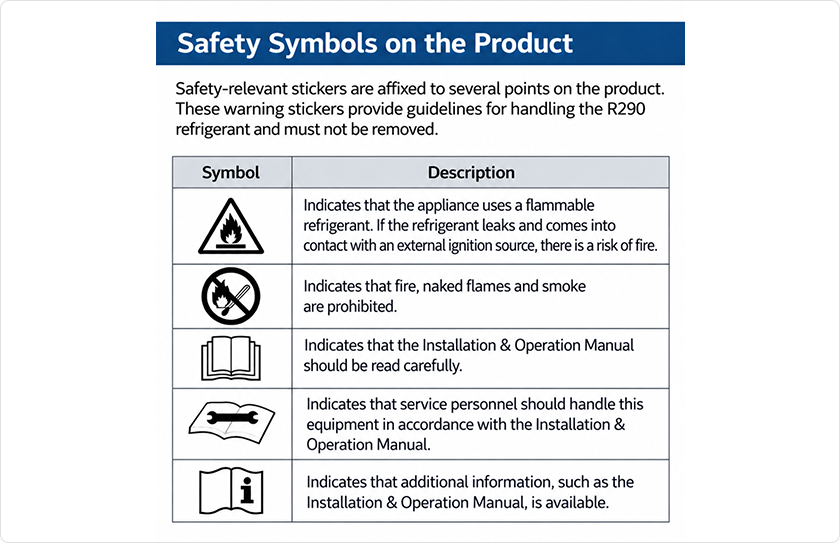
- Product labels that match the manual — Every safety label on the product should be explained in the manual. A table covers the flammable refrigerant symbol, the no-open-flame symbol, and the read-the-manual instructions, and states that warning labels must not be removed.
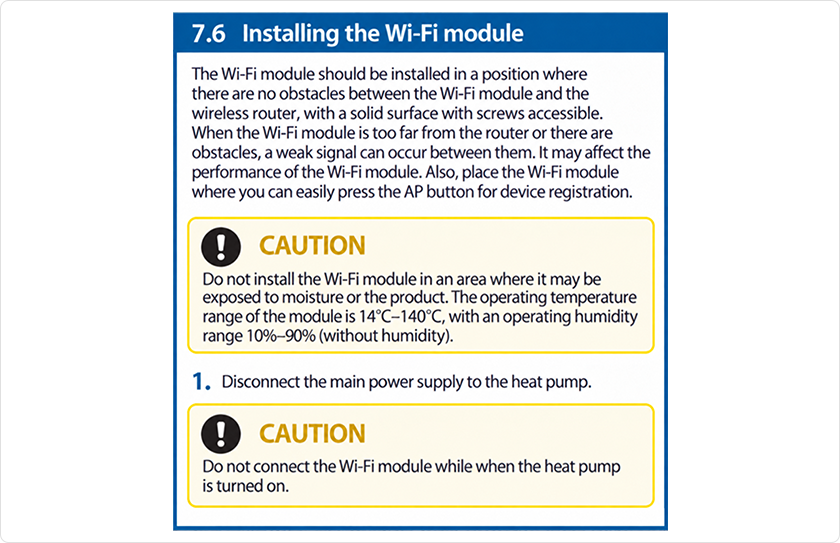
- Warnings that lead to action — A warning shouldn’t stop at naming a hazard. It should tell the reader what to do. Every warning follows the same pattern: hazard, consequence, then action. The electric shock warning, for example, lists four steps: disconnect power, secure it against being switched back on, wait for the capacitors to discharge, and verify zero voltage.
- Warnings where they’re needed — Precautions that must be understood before a procedure appear immediately before it, so readers see them at the moment they matter.
3. Designing Task-Based Operating Instructions
The heat pump is operated from a wall-mounted controller with several layers of menus. Users don’t want a tour of the screens. They want to know how to get something done, and walking through the menus one by one rarely gets them there.
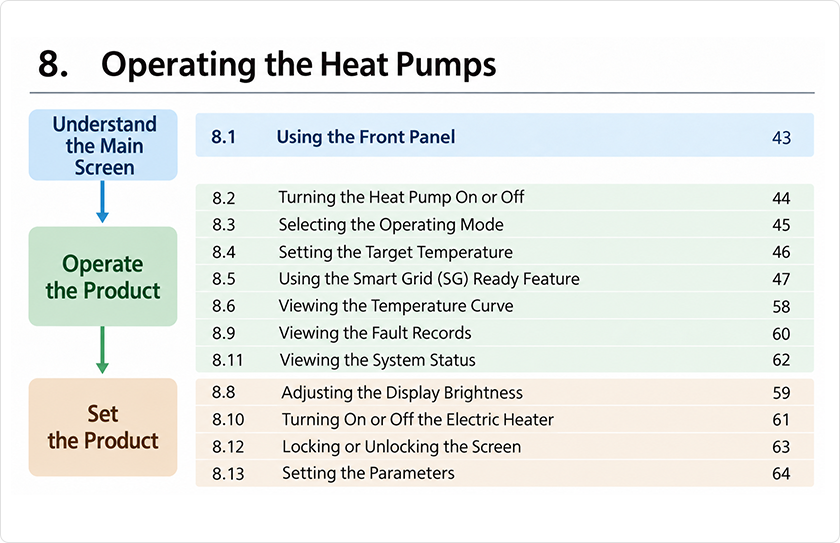
- Identifying user tasks — After mapping every screen provided, we identified the tasks users actually perform and wrote a detailed procedure for each, organized by goal: selecting an operating mode, setting the target temperature, setting a timer, checking the fault history.
- Writing from the user’s goal — Each procedure starts at the home screen and walks through every step until the goal is reached. The table of contents is built on tasks, not on the screen hierarchy.
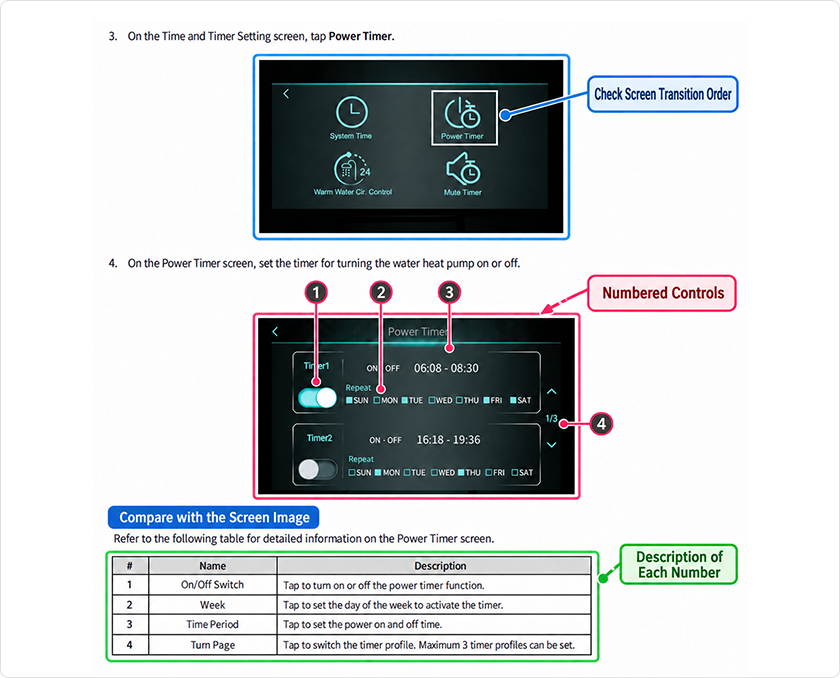
- Screens and steps side by side — Each procedure is broken into steps screen by screen, with an image of that screen alongside. Users can compare what’s in front of them with the manual and confirm the next step.
4. Extending the Manual Beyond Installation
A manual’s job doesn’t end when the unit is installed. Post-installation checks, handover to the homeowner, routine maintenance, and troubleshooting form one continuous workflow, and both regulation and the standard expect the manual to cover all of it.
- Commissioning and handover — IEC/IEEE 82079-1 requires commissioning information as part of the product lifecycle, and the UK Benchmark scheme requires commissioning records to be passed on to the end user. The commissioning chapter sets out an installation checklist, test-run procedures for heating, cooling, and domestic hot water, and a log for operating measurements, followed by dedicated guidance on the Benchmark scheme.
- Maintenance over the product’s life — The maintenance chapter lists inspection items and intervals, along with everyday precautions, casing cleaning, and steps for restarting after a long shutdown. Homeowners and service technicians work from the same reference.
- Troubleshooting — When something goes wrong, the answer should be in the manual. The troubleshooting chapter covers remedies by symptom, solutions by error code, and a full parameter list.
- Built for use on site — Checks come as checklists to tick off, measurements come with space to record them, and troubleshooting starts from either the symptom or the code on the screen. It’s a document you work with, not just one you read.
Outcome
In about one month, Hansem Global delivered a 12-chapter, roughly 90-page Installation & Operation Manual for Navien’s air-to-water heat pump line in the UK and Ireland. The manual meets the information scope required by international standards, provides a complete safety system for a flammable-refrigerant product, and reflects local regulations and installation schemes.
Turning a manufacturer’s technical data into documentation that satisfies both the standard and the market’s regulatory requirements is the core of what Hansem Global offers companies entering new markets. Even on tight development schedules, and in markets whose documentation requirements are unfamiliar, we deliver manuals ready to ship with the product.
Frequently Asked Questions
- Can't we just translate our existing manual for the European market?
- Usually not. In Europe, Ecodesign Regulation (EU) 813/2013 requires heating appliances to include information on installation and maintenance precautions and on disassembly, recycling, and disposal, and IEC/IEEE 82079-1 requires information for every lifecycle stage, including commissioning and troubleshooting. Individual countries add their own requirements. In the UK, the Benchmark scheme requires installation and commissioning records to be handed over to the end user, and heat pump installers typically work to MCS standards. If your existing manual doesn't contain this information, translating it won't close the gap. The first step is to compare your current manual against the target market's requirements. The same holds for any market. In the US, for example, heat pumps are evaluated to UL 60335-2-40, which sets specific marking and instruction requirements for flammable refrigerants, and ANSI Z535.6 is widely used as the reference for safety messages in product manuals.
- What changes in the manual when a product uses a flammable refrigerant?
- Safety information carries more weight and needs more deliberate design. Qualifications and tools for charging, recovering, and transporting refrigerant, control of ignition sources, and ventilation requirements all have to be written as concrete actions the reader can carry out. The manual also has to explain the safety symbols on the product, and warnings work best when they sit right next to the procedures they apply to.
- Do we need organized documentation before we start?
- No. Pulling the information we need out of design documents, screen images, spec sheets, and existing manuals in whatever form they come is part of technical documentation work. Anything the materials don't answer, we compile into a list of questions and confirm with the manufacturer's engineers.
- If we're entering several markets, do we need a separate manual for each?
- Each market has its own requirements, so each needs its own review. But most product information and procedures are the same across markets. By standardizing the shared content and branching only where requirements differ, you can add new markets later without starting from scratch.