




A consumer product launch calls for more than a product announcement. Retail sales teams need product knowledge training, demonstration guides, customer conversation scripts, and sometimes interactive learning and short videos. These sales enablement materials can rarely be finalized on the same day. The practical approach is to start what can be developed with approved information, identify what must wait for final product details, and manage changes across every format before launch.
Do Not Wait Until Product Development Is Complete
For consumer electronics, beauty devices, home appliances, and other retail products, product development, marketing, distribution, and retail sales training often move in parallel. Sales associates may need a product overview to learn key benefits, a demonstration guide to practice using the device, a conversation guide to answer shoppers’ questions, and short videos for refresher training.
Each deliverable has different dependencies. A product training presentation may be outlined once key features and positioning are reasonably clear. A step-by-step demo guide, however, may require the final user interface and operating sequence. The more useful question is what information each training asset needs before work can begin or be approved.
Prioritize Sales Enablement Content by Readiness
Start by identifying the purpose, audience, delivery format, and priority of each asset. A new product presentation may need early attention and can be structured around agreed features and selling points. An interactive product training module can have its learning flow and screen prototypes reviewed before final visuals are available. A hands-on product demonstration guide usually needs stable device behavior and approved interface details before final production.
Separate the inputs needed for concept development from those required for final approval. This allows teams to work in parallel without treating every draft as release-ready.
Illustrative production sequence
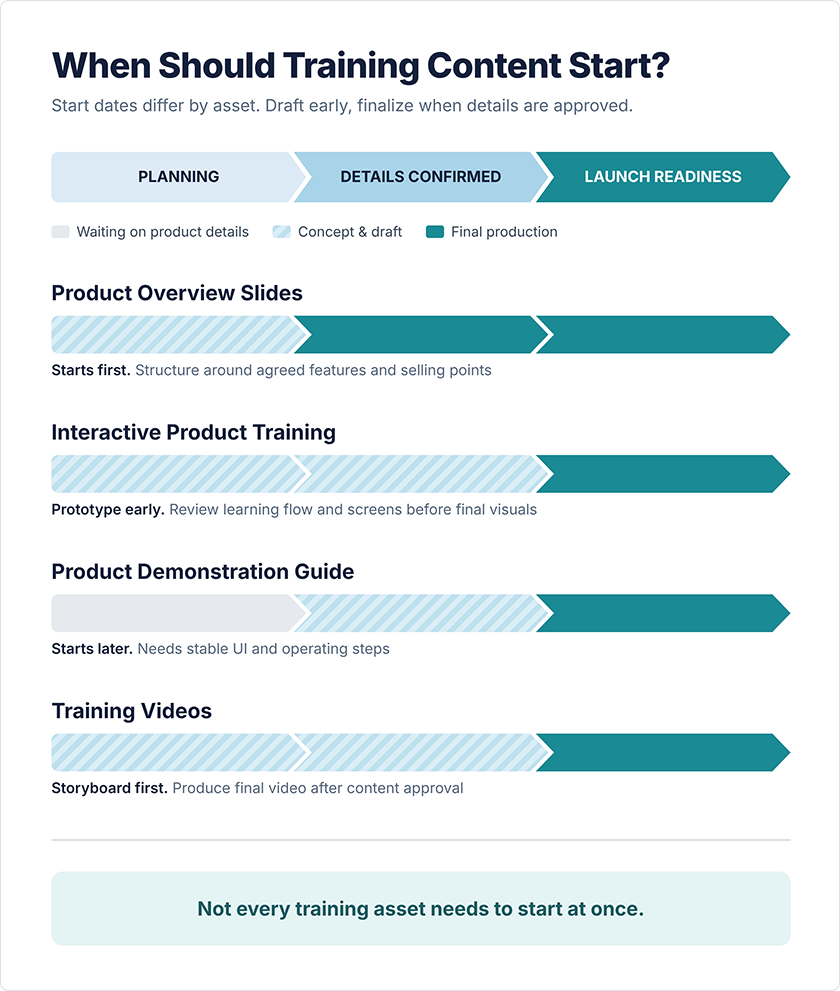
The sequence is illustrative, not a fixed timetable. Actual dependencies vary by product and content format.
Keep Product Messaging Consistent Across Formats
Product launch presentations, sales scripts, demo instructions, quick-reference cards, and training videos may look different, but they rely on the same product facts. If feature names or customer benefit claims vary across assets, reviews take longer and retail associates may receive conflicting information.
Maintain one approved reference for product names, key features, benefits, selling points, usage cautions, and marketing language. The content can then be adapted to its purpose: the same feature becomes a learning topic in a course, a customer benefit in a sales conversation, and an operating step in a product demo. The format changes, but the underlying information stays the same.
Treat Content Approval and Design Approval as Separate Milestones
An approved outline does not mean the copy is final. Likewise, sign-off on visual design does not mean every product claim has been confirmed. Track which elements are approved, under review, or subject to change.
This is especially important for interactive training and video. Revising a storyboard or screen prototype is generally easier than changing a finished sequence. Product, marketing, and learning teams may also give different feedback, so agree on how comments will be consolidated and who has final approval.
Track the Impact of Product Changes
Feature names, screens, operating conditions, and marketing claims can change shortly before launch. Updating each asset in isolation creates the risk that older information remains in a slide, demonstration step, video subtitle, or store quick-reference card.
For each change, record what changed, which assets and scenes are affected, who owns the update, and whether another review is required. A simple impact log helps keep product knowledge training consistent, especially when several languages or regions are involved.
Build Localization and In-Context QA into the Global Launch Plan
A master-language course is not automatically ready for every market. Multilingual retail training materials need translation and localization, followed by checks in the final layout or learning experience. Teams should examine text expansion, interface labels, captions, text embedded in images, and product terminology.
Some translation can begin once the underlying content structure is stable. Content likely to change before sign-off may need to wait or be clearly tracked. Plan backward from each market’s retail training and launch dates to reserve time for source approval, localization, design integration, and final quality assurance.
What Manufacturers Gain from Better Production Planning
- More predictable launch readiness: Teams can begin with confirmed information and identify late dependencies.
- Less duplicate rework: Shared product terminology and messages reduce inconsistent updates.
- Simpler reviews: Defined approval stages help reviewers focus on decisions still needed.
- Consistent global training: Changes can be reflected across localized content and markets.
This approach cannot prevent every launch delay. It can, however, reduce avoidable revisions when product information, creative production, and regional rollouts are changing at the same time.
Product Sales Enablement Content from Hansem Global
Hansem Global supports consumer product manufacturers with product training presentations, interactive learning content, product demonstration guides, retail sales conversation scripts, briefing and training videos, and workshop materials. We translate technical product details into practical content for sales teams and connect planning, writing, design, review, and multilingual localization.
When a launch requires several asset types, an effective starting point is to map the audience, source information, dependencies, and approval sequence for each one. The goal is not simply to produce more content. It is to deliver accurate, usable sales training materials to retail teams when they need them.