




Rise 360’s AI Assistant has made it faster than ever to produce corporate training content. Enter a course topic, tone, and target audience, and within minutes you have a lesson structure, body text, and quiz questions. For L&D teams under pressure to deliver, this is a welcome development.
But open the output, and the gap between speed and quality becomes apparent.
Sentences appear that have no direct connection to the learning objective. Content repeats across sections. Quizzes default to simple true/false or single-select questions that test recall but not judgment. The writing style tends toward long, dense paragraphs — functional for a report, but inefficient for a technician who needs to absorb key points quickly between tasks.
This is not a flaw in the tool. AI is optimized to generate text, not to design learning outcomes. Turning an AI draft into effective training content requires instructional design expertise — and that is a fundamentally human skill.
Hansem Global has built a structured process that combines AI efficiency with instructional design rigor. The result is training content that is produced faster than traditional methods, but refined to a standard where it actually changes learner behavior.
What AI Does Well — and Where It Stops
Hansem Global’s process begins with AI draft generation. Using Rise 360’s AI Assistant, the team inputs course parameters — topic, tone, audience profile, and learning goals — to build an initial lesson outline.
Even at this stage, instructional design thinking is applied. Prompts are tuned with specific persona definitions (‘Straight to the point’, ‘For young busy technicians’, ‘Plain language’) and precise constraints that direct the AI toward outputs aligned with learning objectives. This is not a generic “create a training course” prompt. It defines who the learner is and what behavioral change the content must achieve.
Despite careful prompting, AI drafts consistently exhibit four structural limitations. These are not occasional issues — they appear across projects and content types.
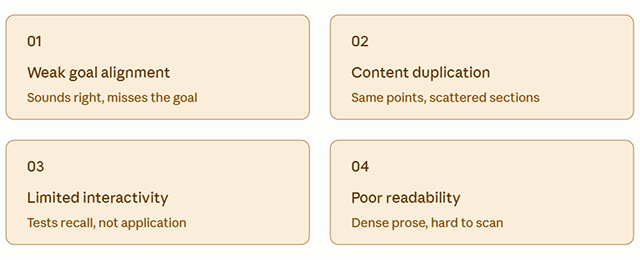
Weak goal alignment. AI generates plausible-sounding text that does not connect to the stated learning objective. Promotional language and filler content appear alongside instructional material.
Content duplication. Similar information is spread across multiple lessons instead of being consolidated. A five-lesson course may contain the same core points repeated in three different sections with slightly different wording.
Limited interactivity. Knowledge-check elements default to basic question formats that test recognition rather than application. The variety and depth of interactive blocks is insufficient to verify real understanding.
Poor readability. AI defaults to paragraph-heavy writing. For field personnel who need to scan content quickly, this format creates unnecessary cognitive load.
How Instructional Design Theory Fills the Gap
Hansem Global addresses these limitations through systematic refinement grounded in established instructional design frameworks. Here is how the key refinements work in practice.
Lesson consolidation through Cognitive Load Theory. Redundant lessons are merged and restructured into microlearning units. The goal is to prevent working memory overload — keeping each learning segment focused on a single, digestible objective.
Content resequencing through Bloom’s Taxonomy. AI-generated content tends to present information in a flat, unstructured list. Hansem Global’s instructional designers reorder this content into a progressive sequence — remember, understand, apply, analyze — so that learning builds incrementally rather than repeating at the same level.
Quiz redesign for behavioral change. Simple true/false questions are replaced with scenario-based assessments that require situational judgment. Grounded in the ARCS model’s confidence dimension, these questions are designed so learners build self-efficacy while developing the ability to apply knowledge in real work situations. Instead of “Which of the following is correct?”, the question becomes “In this situation, what action should you take?”
Sentence-level rewriting. AI prose is rewritten against three criteria. Conciseness — removing modifiers and converting dense paragraphs into scannable formats. Clarity — ensuring learning objectives are immediately visible in every section. Accuracy — identifying and removing data points that the AI inferred rather than sourced from the base material.
Additional frameworks — including Andragogy for self-directed learning design and Gagné’s Nine Events of Instruction for learning flow optimization — are applied based on project requirements.
The same principle applies to images. AI-generated visuals are often technically acceptable but contextually wrong for the training scenario. Hansem Global identifies where images serve a learning purpose, then redesigns prompts with precise specifications — lighting conditions, equipment layout, human activity, and composition — to produce visuals that reinforce the instructional context rather than merely decorating the page. Whether text or image, transforming AI output into a training asset requires the same expert judgment.
What Effective AI-Assisted Training Content Actually Requires
Rise 360’s AI Assistant has made content production dramatically faster. But speed and quality are different problems. An AI draft is a starting point, not a deliverable.
Hansem Global’s approach does not replace AI. It layers instructional design precision on top of AI efficiency. Data extraction and AI drafting provide speed. Theory-based refinement and expert review provide quality. The combination — technology plus human expertise — is what produces training content that drives measurable behavioral change in the field.
For organizations exploring how to scale AI-assisted training content without compromising learning outcomes, Hansem Global combines instructional design methodology with deployment infrastructure built for global rollout.
For more on how Hansem Global handles multilingual deployment of Rise 360 content — including RTL language support, font integrity across 50+ languages, and media localization — see [Mastering Global Reach with Rise 360: The Power of Content Engineering].