



When was the last time you watched a 30-minute corporate training video all the way through? Between meetings, on the way to a client visit, in the few minutes before lunch — a workday is sliced into 5-minute fragments. In this environment, a 30-minute training session is hard even to start.
Microlearning has gained attention against this backdrop. As average attention spans shrink in digital environments and mobile devices become the primary learning channel, traditional lecture-style content is no longer effective in many corporate training contexts.
What Microlearning Is
Microlearning is a short learning unit, typically 5 to 10 minutes long, that addresses a single learning objective. The defining characteristic is not ‘short’ but ‘one clear objective per unit.’
The concept gained traction with the spread of mobile learning and Learning Management Systems (LMS), and has become one of the standard approaches in corporate training. More recently, it has drawn renewed attention through the lens of ‘Learning in the Flow of Work’ — the idea that learning should not require setting aside time as a separate event, but should happen naturally during work itself.
A common misconception is that any short video qualifies as microlearning. It does not. Cutting a long lecture into shorter clips produces ‘short videos,’ not microlearning. Genuine microlearning is designed from the start as a short, single-objective unit.
Why Shorter Lessons Stick
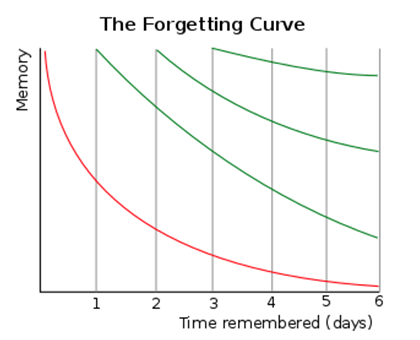
Human memory fades faster than we tend to assume. The ‘Forgetting Curve,’ described by 19th-century German psychologist Hermann Ebbinghaus, shows that roughly half of newly learned information is lost within an hour, and about 70% within 24 hours. No matter how much is taught in one session, most of it is gone by the next day.
A second perspective comes from Cognitive Load Theory. The brain’s working memory has sharply limited capacity, and when too much information arrives at once, learning simply does not occur. It is like trying to cram everything into a small bag — the things you actually need become impossible to find.
Together, these two perspectives point to a clear conclusion. Teaching ten things in 30 minutes is far less effective than meeting one thing at a time across multiple short sessions. Short, frequent learning slows the forgetting curve and reduces working-memory load. The reputation of microlearning as ‘easy to remember’ is not based on intuition — it rests on two pillars of learning science.
Three Conditions of Well-Designed Microlearning
As noted earlier, not every short video is microlearning. The most common mistake is to take a one-hour lecture and slice it into ten 6-minute pieces. The length is shorter, but the learner still has to follow ten things, not one. The viewing format has changed; the learning load has not.
What separates well-designed microlearning from the poorly designed kind? Three conditions, all directly applicable in practice.
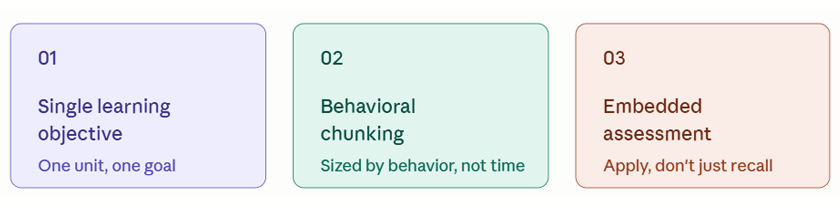
First, a Single Learning Objective. Each unit must have one clear goal. Not ‘New Employee Manual’ — too broad — but ‘How to register a visitor at the front desk,’ specific enough that the learner can answer in one sentence what they can now do.
Second, Behavioral Chunking. Units should be divided by behavior change, not by time. The starting question is not ‘Let’s make a 5-minute version’ but ‘How much is needed to learn this one behavior?’ The end result may be similar in length, but content shaped by these two starting points feels fundamentally different.
Third, Embedded Assessment. A short check should be built into the unit itself. Not a basic true/false quiz, but a scenario-based question that lets the learner immediately apply what they just learned. This is where the ‘I can actually do this now’ feeling — the heart of effective learning — takes hold.
Two five-minute videos can produce very different outcomes depending on whether these three conditions are met.
When to Consider Adoption
Microlearning is not the right fit for every type of training. When evaluating adoption, consider two dimensions.
First, the nature of the content. Microlearning works clearly for areas where specific behaviors or information must be acquired quickly: operating procedures, safety protocols, new product information, customer interaction patterns, system walkthroughs. By contrast, topics requiring deep thinking or complex judgment — leadership development, strategic decision-making, ethical reasoning — are difficult to break into short units and are better served by integrated learning environments.
Second, the learner’s context. Microlearning shows its strongest effects with field personnel, sales teams, shift workers, and others who cannot easily set aside long blocks for training. Whether the content is likely to be consumed on mobile devices is also worth considering.
The rise of AI content generation tools has made it possible to produce microlearning units quickly. But producing them quickly is not the same as producing them effectively. The three conditions outlined above — single learning objective, behavioral chunking, embedded assessment — are not automatically met in AI-generated drafts. Refinement by an instructional designer is what closes that gap.
Hansem Global combines the speed of AI with instructional design refinement to ensure these conditions are met. We cover this approach in detail in [Why AI-Generated Training Content Is Not Ready to Deploy].
If you are considering adopting microlearning in your corporate training program, contact Hansem Global. We can help you evaluate which content fits the format and how to design it for real impact — starting from the questions you should ask before you commission anything.