



For manufacturers in defense, biotech, medical devices, and semiconductor equipment, the riskiest moment in going global is not translation quality — it is the multilingual documentation stage, where pre-release technical data passes through many hands. Hansem Global has designed and operated client-specific secure facilities since 2012, running a five-layer isolation architecture with a record of zero security incidents over more than a decade. This article walks through that architecture, the proprietary tools that keep production moving inside an air-gapped environment, and how a secure setup differs from a standard one.
Why documentation is the riskiest stage of going global
Multilingual documentation is one of the most exposed stages of a global launch. In security-sensitive industries — defense, biotech, medical devices, semiconductor equipment, and any field handling pre-release products or core technology — source material passes through technical writers, project managers, DTP designers, QA, and translators, and along that chain a single NDA leaves blind spots it was never designed to close. For US manufacturers, this material is often export-controlled (ITAR/EAR) or trade-secret data, which raises the stakes well beyond a standard confidentiality agreement.
Consider what is actually moving through that chain: a single design drawing of an unreleased product, one page of a clinical trial report, one line of a defense component specification. It takes only seconds for any of these to leak — and the consequences can erase years of technical lead and first-mover advantage in an instant.
Secure localization means controlling not just translation quality but the entire path the source information travels — how it moves, who can access it, and the environment it is worked in — in line with the client’s security policy. Across 35 years of localization work for global manufacturers, Hansem Global has, since 2012, designed and operated dedicated in-house secure facilities matched to each client’s security requirements. This article lays out the secure localization architecture and operating practices that let security-sensitive companies expand into global markets with confidence.
A five-layer architecture, not a locked room
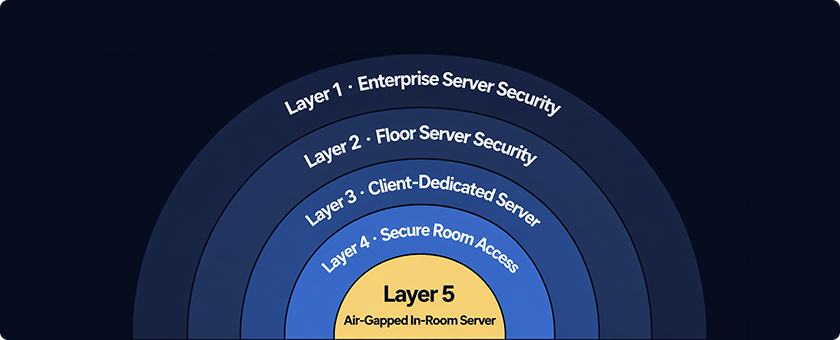
Hansem Global’s secure facility is not simply “a separate room with a locked door.” It is built as five distinct layers of isolation — company-wide servers, floor-level servers, client-dedicated servers, the client-specific secure room, and a dedicated server inside that room.
Even within a single client and a single project, work for different internal departments is separated into different secure rooms and servers, so that information cannot cross between teams inside the same organization.
| Layer | Scope | Control mechanism |
|---|---|---|
| Layer 1 | Company-wide server security | Enterprise-wide common firewall perimeter |
| Layer2 | Floor-level server security | Independent NAT per floor blocks lateral access between floors and movement across segments |
| Layer3 | Client-dedicated server security | An independent instance within the server farm acts as a client-only server |
| Layer4 | Secure-room access security | Physical, card-based entry control |
| Layer5 | In-room dedicated server security | Final working data isolated within a closed, air-gapped network |
Access is controlled per project, not per company
When a secure project begins, everyone directly involved — headquarters staff, overseas-branch staff, and external vendor translators alike — signs a separate security undertaking specific to that project.
System-level controls then block anyone outside that signed group from reaching the secure room or its servers at all. Because rooms and servers can be separated by department even within the same client, the model structurally prevents one project’s information from being exposed to another team working under the same company.
Proprietary tools that keep working when the internet is cut off
PCs inside Hansem Global’s secure room have every external network connection fully severed except a single channel for client communication. An isolated DMZ (demilitarized zone) is formed inside the room, separating and controlling any point of contact with outside networks at the source.
In this environment, conventional commercial tools that assume online authentication — the Adobe and Microsoft suites, for example — run into constraints around license verification, updates, and AI-linked features. Hansem Global treats this not as an exception but as the baseline condition, working with the client’s security team to test every variable in advance.
Rather than depend on internet-reliant commercial tools, Hansem Global has built proprietary tools that run inside the secure room, so automation continues even when cut off from outside networks. For secure projects and confidential documents, general-purpose AI services are excluded entirely, and only validated in-house tools are used.
Practical tip
Adobe and Microsoft licensing and authentication issues are the single most frequent cause of schedule slippage at the start of a secure project. Hansem Global verifies authentication, licenses, fonts, and plugin compatibility against a checklist before any secure project begins, so delays don’t surface once work is already underway.
Environment changes happen only after six months of testing
The most dangerous moment in a secure environment is when servers, hardware, software, or the operating system are replaced.
Hansem Global tests every environment change for at least six months in advance, reports the results to the client, and proceeds only after approval. This guarantees stable, uninterrupted operation even while a secure project is in progress.
Standard localization vs. a secure localization environment
Here is how Hansem Global’s secure localization environment differs from a standard one, across six dimensions:
| Dimension | Standard environment | Hansem Global secure environment |
|---|---|---|
| Server setup | Single shared server | Five-layer separation: company → floor → client → secure room → in-room server |
| Personnel access | Shared access for project staff | Per-project undertaking plus per-department access control |
| Network | Always-on internet, cloud-dependent | Isolated DMZ inside the secure room; all external internet blocked except an essential client channel (full external isolation), backed by proprietary tools |
| AI usage | Open use of general-purpose AI | General-purpose AI excluded; only validated in-house tools |
| Environment changes | Switched immediately when needed | Switched only after 6 months of testing and client approval |
| Operating cost | Standard | Roughly 1.5× or more in both infrastructure and staffing |
Why sustained secure localization is rare — and what it takes
Running a secure facility requires high-cost, high-spec servers optimized for security, high-performance PCs that operate smoothly across multiple security networks, and dedicated, physically separated space.
Secure projects also don’t run year-round. The facility has to sit idle for more than half the year, and staff move back and forth between their regular desks and the secure room, so utilization is hard to keep near 100%. The result is more than 1.5 times the cost of a standard environment, in both equipment and people.
That cost pressure is exactly why smaller providers struggle to start or sustain a secure facility — and why many language service providers don’t run one at all. It is also why clients who begin one secure project with Hansem Global tend to keep the partnership going.
Common questions
Q. What is a secure localization facility, and how is it different from a normal workspace?
It is separated into five layers — company, floor, client-dedicated server, the secure room, and a dedicated server inside that room — and even within the same client, different departments are run on separate rooms and servers to prevent information from crossing between teams.
Q. How does production continue in an environment with no internet access?
PCs in the secure room have all external networks severed except a single client-communication channel. Instead of internet-reliant commercial tools, Hansem Global uses proprietary tools that run inside the room, and excludes general-purpose AI services entirely.
Q. Why does secure localization cost more than standard localization?
It requires high-spec servers and PCs and dedicated, separated space, and the facility sits idle much of the year, keeping utilization low — so both equipment and staffing run roughly 1.5 times the cost of a standard environment.
Going global starts with security
In defense, biotech, medical devices, semiconductor equipment, and other high-sensitivity industries, multilingual localization is no longer a question of translation quality alone. A truly safe global launch depends on controlling how information moves, who can access it, and the environment it is worked in.
Drawing on 35 years of multilingual localization expertise and a record of zero incidents across more than a decade of running a five-layer secure facility, Hansem Global designs a secure localization model matched to your security requirements.
Whether you are launching your first secure project or questioning the stability of your current secure-localization partner, Hansem Global is ready to help you start with the first step of any global launch — security — with confidence.
Fourteen years. Five layers of security. Zero incidents. That is Hansem Global’s commitment.
Coming up in this series
Hansem Global will soon publish a series on a day in the life of the people who work inside the secure room — technical writers, multilingual localization specialists, and retail-marketing creatives (copywriters, graphic and video producers) — and how they fill the gap that an internet-free environment creates, in their own words.