


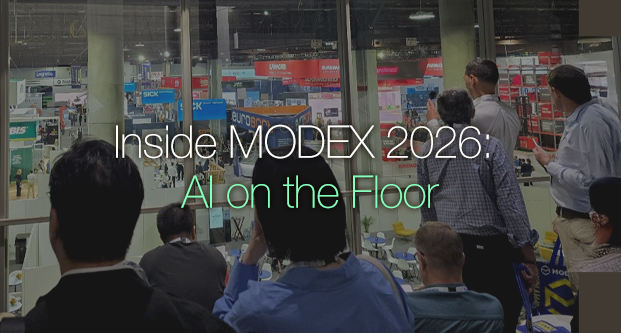

At MODEX 2026 in Atlanta, AI didn’t just show up — it ran the floor. Watching it work raised a quieter question: when warehouse hazards stop being visible, where does technical documentation stand? These are notes from the floor — and the case for what documentation has to become.
On the Floor
Walking into the Atlanta exhibition hall, the first thing that hit me wasn’t a row of polished products on display — it was the equipment in motion. More than a thousand booths stretched out in every direction, prepared by some of the world’s leading logistics and automation companies, and the floor was already packed even though the doors had just opened.

MODEX is a logistics and supply chain show, and the keynote matched the room: direct and unambiguous.
Supply chains are no longer a support function — they are the business. AI is no longer a tool — it runs the operation. Automation is no longer an experiment — it’s already the infrastructure that’s working.
The demonstrations on the floor backed up every word.
Something Started to Bother Me
Watching these AI-run systems operate in near-perfect harmony, I started to feel uneasy.
Have the risks of the warehouse floor really disappeared? Or have they just become harder to see? And if they’ve gone underground, where does technical documentation stand — how is it supposed to warn operators about hazards they can’t even spot?
Risk, Then and Now
The hazards of the warehouse used to be obvious. Hot. Heavy. Sharp. Moving fast. You could see them, point at them, post a caution sign next to them.
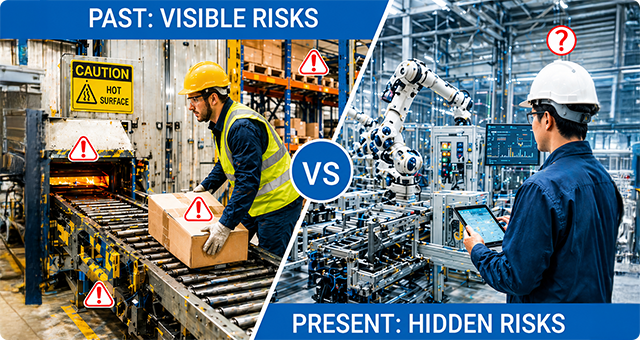
The risks inside an AI-controlled system are different. They’re quiet. They’re hard to predict. They live inside software the operator can’t watch directly. And most of the time, no one knows they’re there — until something actually goes wrong.
We’ve seen this play out in other industries. The moment a driver mistakes a driver-assist system for true autonomy, they’re exposed to serious danger, and they usually don’t recognize the gap until it’s too late.
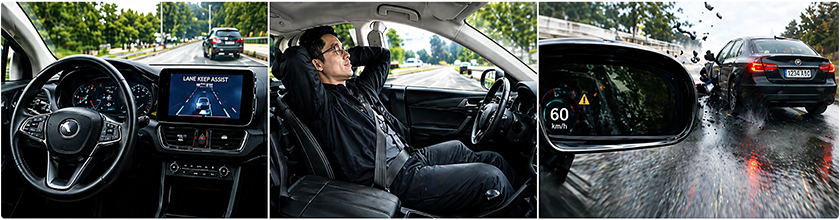
The AI itself isn’t the hazard. The hazard is the gray zone — not knowing exactly when a human is supposed to step in.
What Technical Documentation Has to Become
In an AI-driven environment, technical documentation isn’t a manual anymore. It’s a safety mechanism that operates in the background.
A lot of the time, the procedures aren’t even the point — the AI executes them on its own. What matters now is something the AI can’t do for itself: telling the operator when to step in, and just as importantly, when to back off. Documentation has to draw the line between what the system can be trusted to handle and what it can’t.
That changes what documentation is for. It can no longer be a static set of procedures. It has to behave like part of the system’s safety interface — concise, condition-aware, designed to support fast decisions in real time.
Why Documentation Alone Isn’t Enough
When a situation calls for an instant judgment, safety information can’t be something the operator looks up. It has to be something they already know.
That’s why documentation in an AI-driven environment has to be designed alongside training — not as a separate deliverable, but as a paired system. Documentation lays the groundwork. Training is what turns that groundwork into reflex.
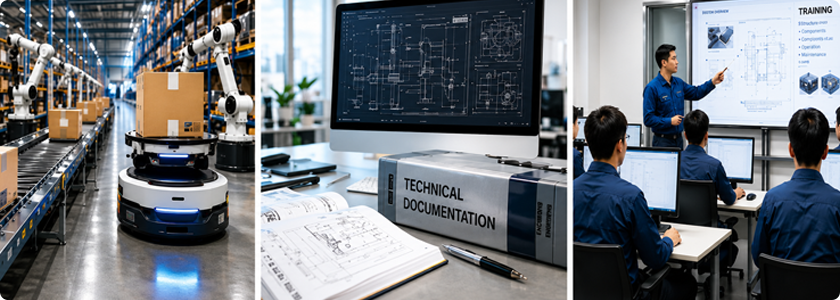
You can write the safest manual ever produced, but if the operator hasn’t internalized it before they reach the floor, it won’t help in the moment the floor needs it. Where risks are hidden, operators have to understand the workflow well enough to decide for themselves when to intervene and when to step back. That kind of understanding doesn’t come from reading a document mid-shift.
What MODEX 2026 Was Really About
MODEX 2026 wasn’t a show about how far automation has come. It was a show about who’s responsible for it — and how that responsibility gets handed off when something does go wrong.
If AI automation ever becomes fully self-sufficient, will technical documentation still matter? As long as a human is anywhere in the loop — and there will be — yes. The document won’t disappear. But what it does, and how it’s structured, has to change.
In a complex automated environment, documentation has to explain the system as a whole and deliver safety guidance that’s concise enough to act on under pressure.
But information delivery alone won’t keep people safe anymore. Safety in an AI-driven environment isn’t a matter of understanding. It’s a matter of response.
Reflexes don’t come from a manual. They come from practice. So technical documentation has to be paired with a training program built to develop those reflexes — role-based scenarios, repetition, the kind of practice that simulates the moments where judgment actually matters.
Documentation sets the standard. Training makes the standard show up on the floor. Operations is where the two finally meet.
That integration — documentation, training, and field operations working as one system — is what AI safety actually looks like.
As AI takes over more of the work, technical documentation has stopped being a deliverable. It’s become the connective tissue between users and the systems they depend on.
Hansem Global designs that connective tissue. We build technical documentation and training programs that turn complex systems into knowledge operators can act on — in any market, in any language.