


Not every documentation team faces this problem. But when one product platform branches into dozens of model and market variants at the initial launch, all within the same release window, manual production becomes a different kind of operation. Drawing on more than fifteen years of continuous experience with a high-variant, platform-based documentation program, this paper examines how documentation teams identify what must change in each derivative, confirm those changes, and carry them through production without omission.
Table of Contents
- Executive Summary
- 1. This is not every documentation team’s problem
- 2. One platform, dozens of manuals, one launch window
- 3. Production begins by building the questions the responsible teams need to answer
- 4. What the changes actually look like
- 5. From scattered evidence to a confirmed change set
- 6. Why AI did not reduce the work of finding changes
- 7. What has to be in place at this scale
- 8. The skill set changes in high-variant documentation
- 9. Documentation operations, not a series of isolated projects
- 10. What this means for your documentation team
Executive Summary
- This is a specialized documentation problem. It appears when one common platform must generate many separate manuals by model, hardware configuration, or market at the initial launch.
- The documentation team rarely receives one complete change document. Relevant information is distributed across email, specifications, screen data, certification information, and other materials exchanged among product and engineering organizations.
- The hardest part is not authoring or translation. It is identifying every manual-impacting change before derivative production starts.
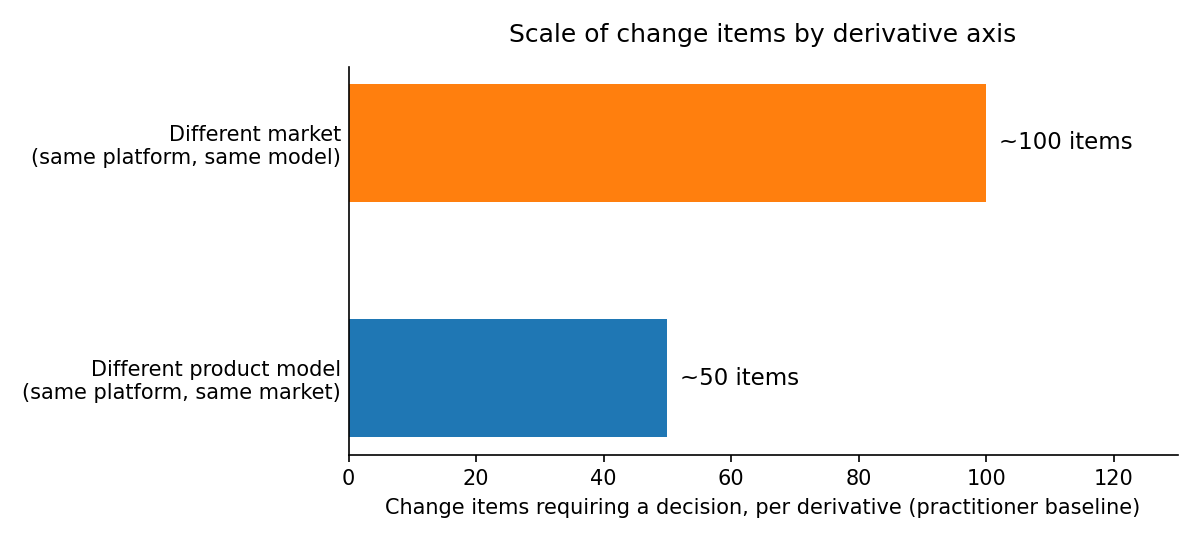
- The number of change items requiring a decision is smaller than most people expect: roughly 50 for a different product model on the same platform, and roughly 100 for a different market. The difficulty is not the count. It is that a single decision is applied across the manual in many separate places, close to half of them a single sentence or a single table entry.
- Market derivatives carry more change items, and the spread between markets is wide. Adjacent markets with similar specifications and languages can be 90-95% identical, while markets that diverge on regulation and available services differ considerably more. One market-level difference propagated through multiple chapters, settings, references, and the specification table.
- The working method is to reconstruct potential manual impacts from scattered evidence, turn each one into a specific confirmation request supported by the relevant manual content and source material, and begin derivative production only after each point is confirmed, rejected, or revised.
- Attempts to use AI to identify these changes from email-based correspondence did not reduce the workload. The candidate output became broader than the work an experienced coordinator needed to review directly.
- At this scale, continuity matters. Product history, prior decisions, traceable change records, and repeatable review processes must survive from one release to the next.
1. This is not every documentation team’s problem
Many documentation teams can manage product variations without a specialized operating model. If a company releases only a few derivatives each year, an experienced writer or coordinator can often keep track of the differences through normal project management.
The problem changes when a common platform branches in several directions at once. A base manual may be adapted to different hardware configurations or product models, then adapted again for different markets. Once language versions are added, the number of deliverables multiplies quickly. The work is no longer a sequence of separate manual projects. Several related manuals have to be established and produced in parallel.
This paper is for teams operating in that narrower situation: multiple product or market derivatives, separate manual deliverables, and a common launch window. The measured example comes from an anonymized platform-based product line, but the operating question is broader: how do you control changes when many related manuals must move at the same time?
2. One platform, dozens of manuals, one launch window
Manual production cannot begin until product development is far enough along for screens, functions, and specifications to be usable. It also cannot finish after the product launches. The documentation team controls neither boundary.
Inside that fixed window, the team has to establish the content of multiple derivative manuals and then produce the required language versions. Software updates and design changes continue to arrive during the same period. A late change may therefore trigger not one revision, but a set of revisions across several related manuals.
Scale is what changes the nature of the work. A missed change in one source manual can be replicated into multiple derivatives and then into multiple language versions. The risk does not grow only with page count; it grows with the number of dependencies between variants.
3. Production begins by building the questions the responsible teams need to answer
The documentation team does not normally receive a clean document that says: change this sentence on page 42, delete this feature on page 118, revise this screen on page 205, and update this specification table on page 367. The information exists, but it is distributed across the organizations that own different parts of the product.
Software, electronics, engineering, and product teams report the changes they manage. Regional, certification, or regulatory information arrives through other channels. Each source may be correct within its own scope, but none of them is responsible for translating the total set of changes into a page-by-page revision plan for the manual.
That interpretation is the real starting point of derivative production. Documentation specialists trace the exchanges and attachments, determine which items may affect the manual, connect each item to the exact content involved, and formulate a specific question for the responsible decision owner to confirm. The team is not simply asking, “What changed?” It is asking, “We believe this change affects this point in the manual in this way. Is that correct?”
4. What the changes actually look like
To understand the identification problem, it helps to separate the two axes along which derivatives branch. In practice, a derivative for a different product model on the same platform involves roughly 50 change items requiring a decision; a derivative for a different market involves roughly 100. Those are manageable counts. What makes the work difficult is how those decisions land in the document. Comparing shipped manuals along the two axes shows two very different patterns.
Methodology note: All case examples and measured data in this paper have been anonymized. Customer, product, platform, and internal project identifiers have been removed or generalized.
Dispersed changes across models
For a different product model, the roughly 50 change items translate into a far larger number of edit locations. A single revised notation convention alters every occurrence of that notation; a single specification difference touches the conditional wording in several sentences. In the pair we compared, the edits were scattered across the full manual, and close to half of the locations were a single sentence or a single table entry. One decision, many places.
A physical control may be present in one model and absent in another. A condition may be added inside an otherwise identical sentence. A UI naming or capitalization rule may change between production cycles. Market differences can also affect radio standards or spelling conventions. None of these necessarily arrives as a consolidated list. They have to be found and connected to the manual.
Propagating changes across markets
Market derivatives carry more change items, around 100, but the spread between markets is wide. For adjacent markets with similar specifications and languages, 90-95% of the content is typically identical; in the pair we measured, it was 98%. Where regulation and available services diverge, the gap is considerably larger. What matters is that the remaining difference does not stay in one place.
One market did not offer a connected service that was available in the other. That single fact affected the service chapter and related functions, changed profile sign-in information, reached a specification-table entry, and required a cross-reference elsewhere in the manual to be rewritten. A difference that begins as one market fact can travel through several parts of the document.
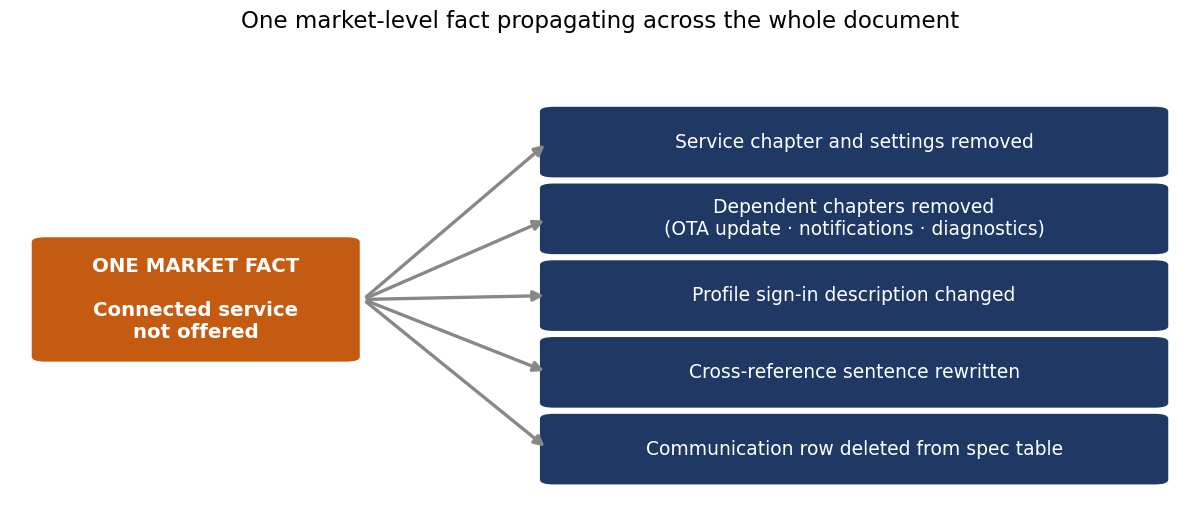
These two patterns create different risks. Dispersed changes are easy to miss because they are small and widely distributed. Propagating changes are easy to underestimate because one decision creates consequences far from the point where the change began.
5. From scattered evidence to a confirmed change set
A robust high-variant documentation workflow should not begin derivative production by copying the base manual and editing from memory. It should first reconstruct the likely manual impact from the evidence available across the product organization.
For each candidate change, the specialist assembles the evidence needed to make the issue reviewable. Depending on the point, that may include the current manual passage, a newly captured product screen, a string file, a specification, a previous confirmation record, or correspondence from a related model or system. The purpose is not to collect everything. It is to show why this exact point in the manual may need to change.
Those findings are compiled into a structured change-inquiry package and routed to the responsible decision owners. Each item states the proposed treatment or the open question at a concrete location: replace this screen, retain the current wording, add this feature if the specification applies, or confirm whether a change seen in a related model should also be carried into the target derivative.
The documentation team does not wait for a consolidated change list. It builds the questions that the responsible teams need to answer.
The responsible organization then confirms each point with the appropriate product, software, UX/UI, engineering, or market team when necessary. Some candidates become approved revisions. Others are explicitly confirmed as “retain existing.” Still others are revised after additional checking. Only after the open points are resolved does the confirmed change set become the basis for derivative manual production.
What confirmation actually resolves
In one anonymized case, a newly captured screen suggested that a feature might be available on the target variant, but the screen alone was not sufficient to confirm applicability. The inquiry therefore paired the affected manual section with the latest screen and asked the responsible product or engineering team to verify the specification. The answer determined whether the feature was added or the existing manual content was intentionally retained.
In another anonymized case, a change already confirmed for a related configuration could not simply be propagated to the target variant. The target variant had a different feature set, so the documentation team requested a separate confirmation rather than assuming that the earlier decision applied. This is why confirmation is part of change identification, not a final approval step after editing has already begun.
6. Why AI did not reduce the work of finding changes
The most stressful part of this process for experienced coordinators is the possibility that one change signal may have been missed. In the program behind this paper, considerable time was spent examining whether AI could help detect change points before derivative production.
Most of the relevant information was email-based. Dozens of messages could arrive in a day, which meant thousands over a month. Each new message also carried a long thread of previous exchanges, often with attached material that had changed over time.
Ignoring the older thread history was not an option. A change could be discussed and revised several times, then a later message could ask for a return to an earlier state. The state that had to be restored might exist only in the older part of the thread.
The team also tested the patterns experienced coordinators use when they look for changes. The problem was not simply whether AI could find relevant phrases. To avoid missing something, the output had to include a very broad set of candidates. The volume became so large that reviewing the AI output required more work than an experienced coordinator needed to examine the correspondence directly.
In other words, automation did not reduce the work of identifying what had changed. It increased the amount of material that had to be reviewed.
An experienced coordinator works differently. They do not read every message. They know which senders, stages, issues, previous decisions, and attachments matter. They also know what can be passed over without opening it. When a request says to revert to an earlier state, they understand which earlier state is meant. The advantage is not faster reading. It is knowing what does not need to be read.
This should be distinguished from automated checks used elsewhere in document production. Mechanical comparison or rule-based QA can be useful once the required changes are already known. They did not solve the change-identification problem described here.
7. What has to be in place at this scale
The operating model follows a sequence: find the signal, connect it to a specific manual impact, build an evidence-backed inquiry, resolve the point with the responsible decision owner, preserve the decision, and carry it through production without loss. Six practices make that possible.
- Trace change signals before they become document errors. The team follows the exchanges and attached materials that matter to the manual rather than waiting for one complete change package to arrive. When information is missing, the documentation coordinator asks for it.
- Connect each signal to a concrete manual location. A possible product change is not useful until the team can show which sentence, screen, table entry, note, or section it may affect in the current base manual.
- Build an evidence-backed inquiry. Each candidate is presented with only the material needed to support the question: the current manual content and, as relevant, a latest screen, string, specification, prior decision, or related-model history.
- Resolve each point before derivative production. The responsible decision owner confirms, rejects, or revises the proposed treatment, sometimes after routing the issue to the appropriate product or engineering team. “No change” is also a decision and is recorded as such.
- Preserve the reason and history behind each decision. A later derivative may depend on a previous conclusion, including a conclusion that was later reversed. The decision trail has to survive personnel changes and subsequent release cycles.
- Carry the confirmed decisions through production and trace their downstream impact. Authoring, editing, localization, layout, and review must apply the approved change set consistently, while dependent references, settings, functions, and specification entries are checked to the end.
The process is documented, but it still depends on people who understand the product and its history. Process without experience can move a project forward on an incomplete interpretation. Experience without process leaves too much knowledge in one person’s memory. High-variant documentation requires both.
8. The skill set changes in high-variant documentation
In this type of work, prose ability is not the primary differentiator. The latitude for writing is relatively low because most of the manual already exists and much of the content must remain stable across variants.
The difficult skills are detection and traceability: finding small changes distributed across a large manual, understanding which external information matters to the document, and following one change through every place it affects. These skills accumulate over repeated release cycles.
That accumulated context is also what makes prior content and translation assets usable. Reuse is valuable only when the team knows which content can remain unchanged and which content has to be revalidated for the current derivative.
9. Documentation operations, not a series of isolated projects
High-variant documentation does not work well as a sequence of unrelated purchase orders. To judge the current derivative, the team often needs the history of the previous derivative and knowledge of which organization owns which decision. If that context is repeatedly lost, it has to be rebuilt under launch pressure.
The more useful operating model is continuous documentation operations: stable product knowledge, traceable change history, confirmed source decisions, reusable content and translation assets, and repeatable quality controls that carry from one release to the next.
Hansem Global began as a technical writing company in 1990 and later expanded that work into multilingual localization. The same operating principle applies whether the documentation function is in-house or supported by an external partner: the central problem is documentation engineering and change control; translation is one downstream part of the operation.
10. What this means for your documentation team
If your organization releases multiple manuals from a common product platform within the same launch window, the following questions are useful tests of the current process:
- Before derivative production starts, can your team show which points in the base manual may need to change and what evidence led to each one?
- Can each candidate change be turned into a specific, answerable question for the responsible product or engineering team rather than a general request to “confirm changes”?
- Are candidate changes confirmed, rejected, or explicitly retained before they are multiplied into downstream manuals and language versions?
- When one feature or chapter changes, can you trace its impact to references, settings, dependent functions, and specification information elsewhere in the manual?
- Can the evidence and reasoning behind an earlier decision be recovered months later, including cases where a later instruction reverted to a previous state?
- Does the process still work when the assigned coordinator changes, or does critical context remain in one person’s memory?
A practical way to test the process is to take one representative base manual and one completed derivative and reconstruct how each change was known before production began. If the answer depends on scattered correspondence, individual memory, or assumptions carried over from a related model, the main risk is not writing speed. It is whether the correct questions are being asked early enough.