



Technical documentation defines the standard people are supposed to follow. Training content is designed to turn that standard into action. Applying the learning-design principles we observed at ATD26, manufacturers can take the most critical topics already sitting in their technical documentation and extend them into behavior-focused microlearning. This is the intersection Hansem Global is exploring: turning accurate documentation into something people actually do.
When good documentation isn’t enough
Manufacturers invest heavily in documentation. Operator manuals, service manuals, dealer guides capture every procedure, specification, warning, and exception a user might need. Delivered well, on the web or in print, this documentation is complete and accurate.
But completeness is not the same as competence. In the field, what matters is not whether the information exists, but whether a technician, operator, or dealer recalls the right standard at the right moment, judges the situation correctly, and acts on it, reliably, every time.
That is where documentation meets learning. If technical documentation answers “what is the standard,” training content answers “how do we turn that standard into action.”
Interestingly, very few manufacturers take this second step today. Most stop at producing excellent documentation and assume the field will absorb it. When problems surface, the common response is to add people: a trainer here, a field specialist there. That often costs more than the problem itself. The idea of deliberately reworking documentation into training content is, for most manufacturers, still largely unexplored territory.
What we saw at ATD26
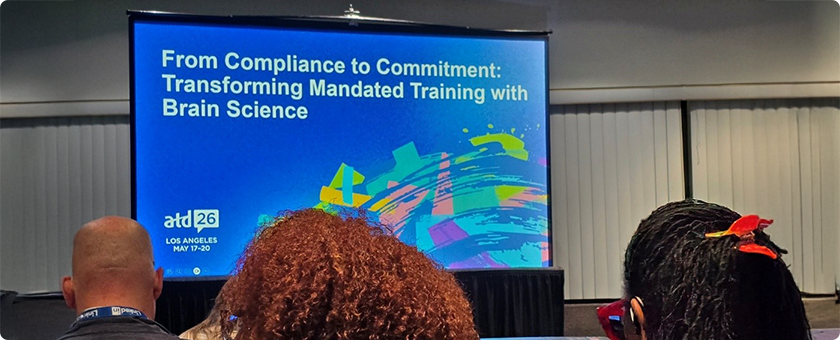
At ATD26 in Los Angeles, one session stood out: “From Compliance to Commitment: Transforming Mandated Training With Brain Science.” It focused on the training organizations are required to deliver, such as regulatory, security, safety, and ethics training, and how to move it from a box-checking exercise to something that actually changes behavior.
Most mandated training optimizes for completion. Watch the module, pass the quiz, log the record, done. But a completion record says nothing about whether behavior changed.
The session’s central point was simple:
The first question is not “what content should we cover?” but “what behavior are we trying to change?”
To get there, the presenter introduced the AGES model (Attention, Generation, Emotion, Spacing) a framework for capturing attention, letting learners construct meaning themselves, connecting emotionally, and reinforcing over spaced intervals. But the more important takeaway was the shift in perspective: design first for what the learner must be able to do in a real situation, not for how much content you can deliver.
Let them judge before you explain
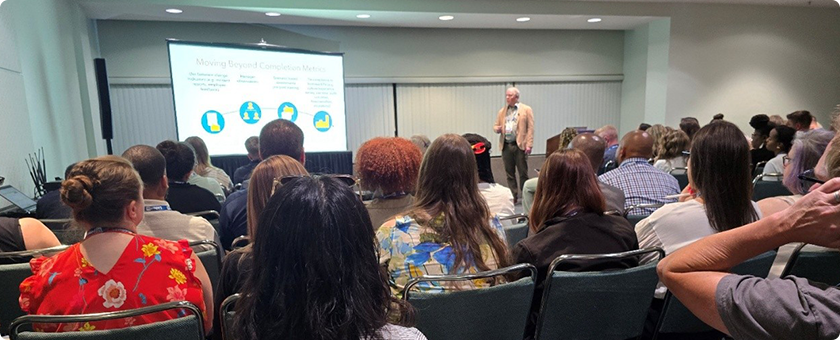
The most striking idea in the session was this: lead with the scenario, not the explanation.
Typical training explains the policy or procedure first, then offers a case or quiz at the end. The presenter argued for reversing that order. Present a real situation first, then ask: “What would you do?”
That question captures attention, activates what the learner already knows, and makes them test their own judgment. When the procedure is explained afterward, the learner receives it not as an information dump but as a standard that sharpens a judgment they’ve already begun making. Content stops being something pushed at people and becomes something they were ready to receive.
From a documentation mindset to a learning mindset
For a documentation developer, the priority is accuracy. Every procedure, standard, specification, warning, and exception must be captured so that any user performs the task to the same standard. The guiding questions are:
- What needs to be explained?
- In what order should the steps appear?
- Which warnings and cautions must be included?
- Where do the exceptions belong?
Shift to a learning-content mindset and the questions change:
- What must the learner be able to do?
- In which situations must they make which decisions?
- Which mistakes must be reduced?
- What is the minimum information required to produce that behavior?
Turning documentation into training content is not about making the document shorter. It is about redesigning the standards inside it into units of behavior.
| Documentation mindset | Learning mindset |
|---|---|
| Organize product features and conditions of use | Teach the context and judgment for using them |
| Explain procedures in the correct order | Have people select and apply procedures in real situations |
| State warnings and cautions clearly | Have people recognize hazards and choose the right action |
| Provide troubleshooting steps | Have people diagnose cause and response from symptoms |
| Specify standards and exceptions | Have people identify and respond to violations |
A key idea in this shift is the minimum effective dose. Documentation must be complete. Training content, on the other hand, doesn’t need to carry every piece of information with equal weight. It selects only what’s needed to change behavior, and fills the rest with scenarios, questions, feedback, and job aids like checklists.
So the direction is not simply chopping a document into smaller pieces. It is using the accurate standards in the documentation as the foundation, and redesigning content so people judge and act correctly in real situations.
A concrete example: from a manual topic to a training module
Consider an EV service manual. Among its many topics is battery replacement — one procedure among hundreds, but a high-risk one. Rather than asking a technician to absorb the entire manual, you can lift out that single critical procedure and rebuild it: re-sequence the steps for how the work actually happens, add video, check comprehension with a quiz that measures whether the technician truly got it, and track who has and hasn’t completed it.
That is what training content does that documentation alone cannot. It selects the topics where the cost of getting it wrong is highest, and turns them into something measurable: “here is what you must be able to do, and here’s how we know you can.”
Where AI fits, and where it doesn’t
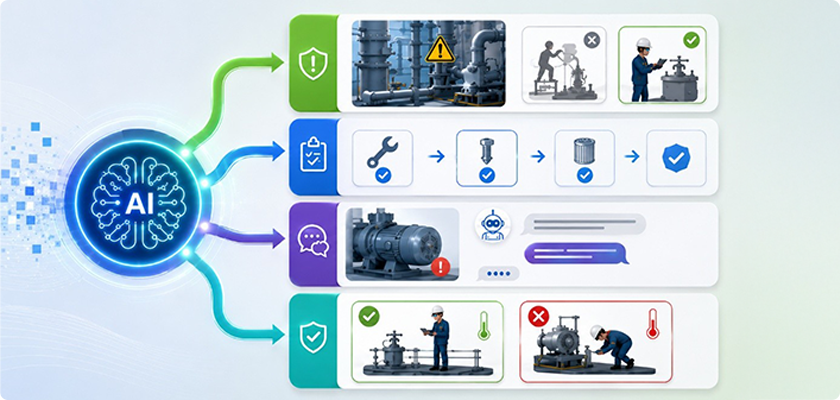
AI came up in the session too. An LLM can draft learning content that already applies a framework like AGES. AI video tools, meanwhile, can turn a real scenario into a more vivid experience. Used with a microlearning mindset, AI becomes a way to extend the standards inside documentation into many forms of behavioral practice — not a way to replace the people who design it.
| Documentation element | AI-assisted microlearning |
|---|---|
| Safety warning | Generate hazard scenarios and multiple-choice checks |
| Maintenance procedure | Derive step-by-step judgment questions and error-prevention points |
| Troubleshooting | Draft symptom-based interactive simulations |
| Conditions of use | Compare correct vs. incorrect use cases |
| Field cases | Reconstruct as AI video or interactive stories |
But it’s worth being precise about a question many manufacturers are now asking: if we can load our documentation into an AI and let the field ask it questions, why build training content at all?
It’s a fair question, and the AI-Q&A approach is real. Feed accurate documentation to a model and it can answer what a user asks, even expand on it and tailor the depth to the person. But three things don’t go away:
- AI answers the question that’s asked. It doesn’t decide what someone must know. The dangerous gaps are usually the ones a person doesn’t know they have, so they never ask. Training content specifies, up front, what everyone must learn.
- Self-directed AI learning varies by person. Some learn well from it; others never engage. What a manufacturer needs is not a few power users but the whole field reaching a reliable baseline. Training content sets that baseline and confirms who has met it.
- Not every team can open its documentation to a public model, and standing up a closed environment just for this can cost more than the value it returns. Training content, built once from the critical topics, is a self-contained asset an organization can distribute and manage internally.
None of this makes AI less useful. It clarifies the division of labor: AI answers whoever asks, while training content makes sure everyone who must know actually learns, and confirms it. The two aren’t competing tools. And the harder, more valuable layer, deciding what to teach and how to confirm it’s been learned, can only be built by people who understand what the documentation means and why.
Where Hansem Global fits
None of this is a service we’re announcing today. It’s a direction we’re studying — because we believe it will matter to the manufacturers we work with.
Hansem Global has spent more than 35 years developing and localizing technical documentation for global manufacturers. That work means we understand the standards and intent inside a document, not just its words. If turning documentation into training content is about preserving those standards while redesigning them for action, then a documentation-native company starts from a place a generic instructional-design shop cannot — with the source content, and with a deep understanding of what it is actually for.
We’re sharing this now less to sell than to think out loud — so that when a manufacturer starts wondering how to turn its most critical manual topics into training people actually act on, the question feels a little less unexplored.
From documents you read to content you act on
Accurate documentation still matters. But the future of technical content won’t stop at delivering information. It will also design for how people recall a standard, judge, and act in a real situation. ATD26 made that direction clear:
The point isn’t to chop content into smaller pieces. It’s to design for better action: let people judge before you explain, and build experiences that carry into what they do.
Technical documentation sets the standard, training content helps people act on it, and AI multiplies the forms that practice can take. When the three come together, content stops being something you read and becomes a tool that changes how work gets done.
Frequently asked questions
How do technical documents and training content differ?
Technical documentation defines “what the standard is.” Training content designs “how to turn that standard into action.”
We already produce good documentation. Why would we need training content too?
Documentation is a complete reference covering usage, service, and dealer information. In principle, a user has to work through all of it. Rather than teaching everything equally, it chooses what matters most and makes people able to do it. In an EV service manual, for example, you can lift out the high-risk “battery replacement” procedure alone, re-sequence it, add video, measure comprehension with a quiz, and confirm who has completed it. It isn’t teaching everything equally; it’s choosing what matters most and making people able to do it.
Can’t we just let the field learn from AI on its own?
Load documentation into an AI and it can answer users’ questions on demand. But AI answers only what’s asked. It doesn’t decide what someone must know, and the most dangerous gaps are the ones people don’t know to ask about. Results also vary widely by individual, whereas what a manufacturer needs is the whole field reaching a reliable baseline, not a few power users. Training content specifies what must be learned and confirms who has learned it. The two aren’t competing tools. Each plays a different role.
How is AI used to turn documentation into training content?
As a tool to extend the standards inside a document into varied behavioral practice — scenarios, multiple-choice checks, interactive simulations. The accuracy and safety of any draft is verified by documentation experts and learning designers.
About Hansem Global
Founded in 1990, Hansem Global is Korea’s first technical documentation company, with more than 35 years of experience developing and localizing technical documentation for global manufacturers.