



When a company outside Asia needs its documentation in Korean, Japanese, or Chinese, the search for a partner usually begins with a ranking. The credible lists come from three firms that study the language industry every year: CSA Research, Nimdzi, and Slator. They are a sound place to start. For Asian-language work in particular, though, a high position on a global list answers a different question than the one a buyer is actually asking.
What the rankings measure
All three lists rank companies on global revenue, and in 2026 each of them widened its scope. CSA Research renamed its list the CSA Research Verified 100 and extended it from language services to language and global content solutions. Nimdzi began admitting platform and AI-first companies alongside traditional providers. Slator retired the term language service provider from its index and replaced it with two categories, Language Solutions Integrators and Language Technology Platforms.
Three firms with different methods moved in the same direction within the same year. That shift says something real about the market. It also has a plain consequence for anyone shopping for Asian-language services. The number on the list reflects a company’s total global scale. It says nothing about how much of that company’s Asian-language work is performed in-house, or by whom.
Who actually performs the work
For Asian-language work, it helps to understand the delivery model behind the proposal. Large providers may use a mix of internal teams, regional offices, and external language specialists. The model itself is not the issue. What buyers need to understand is who actually performs the work, how many organizations touch the content, and who remains accountable for final quality.
A ranking cannot answer those questions. The provider should be able to explain where Korean, Japanese, Chinese, and other Asian-language work is managed and reviewed, and how issues are resolved by the team responsible for the account.
For Asian Languages, Geography Still Matters
The 2026 Nimdzi 100 includes seventeen Asia-headquartered companies: eight in China, six in Japan, and one each in Korea, Taiwan, and Singapore.
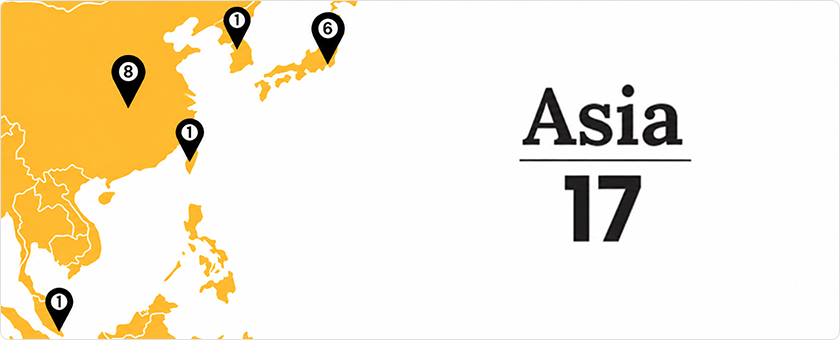
For manufacturers localizing technical content into Asian markets, that distribution is worth noticing. A global ranking shows scale, but it does not necessarily show the depth of a provider’s operating presence in the region. When Asian languages represent a significant part of a localization program, Asia-based specialists are therefore worth including in the supplier evaluation.
Korea is represented by just one company on the Nimdzi 100: Hansem Global. Since 1990, Hansem Global has developed technical documentation for manufacturers and expanded that work into multilingual localization, bringing authoring, terminology, translation, document engineering, and multilingual publishing into the same service model.
What to check before you choose
A ranking narrows the field. Everything that decides quality comes from the questions you ask next. For Asian-language technical work, six are worth putting directly to any provider.
- Relevant industry and documentation experience. Technical manuals for industrial equipment require different knowledge from game or marketing localization. Ask whether the provider has handled products and documentation comparable to yours.
- Delivery model and accountability. Confirm who manages and performs the Asian-language work, how many organizations handle the content before final delivery, and who remains accountable for quality when an issue arises.
- In-region language depth. Ask which target languages are covered by reviewers based in the market itself, and how the provider staffs the languages your program actually needs rather than the ones easiest to source.
- Multilingual publishing capability. East Asian scripts, line-breaking rules, font substitution, and layout expansion can create problems after translation. Ask which multilingual DTP and publishing processes are handled inside the company and which are handed to outside vendors.
- Standards and certification scope. For exported product documentation, confirm applied experience with relevant information-for-use and safety standards, such as IEC/IEEE 82079-1, ANSI Z535, ISO 3864, and ISO 7010, where applicable. For certifications, check the scope rather than the logo alone: ISO 17100 for translation, ISO 18587 for machine-translation post-editing, ISO 27001 for information security, and, if ISO 9001 is cited, what process the certification actually covers.
- Team continuity. Documentation programs run for years. Ask how long the team assigned to an account usually stays in place, because the terminology and style precedent built over time is what keeps quality steady across product revisions.
Matching the partner to the scale of the work
The right level of scrutiny depends on the size of the work. For a handful of one-off documents, a ranking barely matters. Relevant experience and a realistic turnaround decide the outcome, along with how clearly the provider communicates day to day. For a full product line localized across Asian markets over several years, the picture changes. The engagement becomes a long relationship, so the provider’s continuity and in-region depth carry real weight, and a steady presence on the research lists across several years becomes a useful signal of stability.
The bottom line
A ranking tells you a company reached a certain scale in a defined sector. It does not tell you how your Korean, Japanese, or other Asian-language work will be staffed, managed, or reviewed. Those answers come from supplier due diligence, and for Asian-language technical work they matter more than placement.
Hansem Global is an authoring-first language service provider headquartered in Korea, with offices in the United States and Vietnam. Since 1990 it has developed technical documentation and localized it into more than 100 languages, with authoring, translation, and multilingual DTP handled inside the same organization. The company holds ISO 17100, ISO 18587, and ISO 27001 certification, along with ISO 9001 scoped to the manual development process itself. Hansem Global appears on all three 2026 rankings, including 37th on the CSA Research Verified 100.
If you are evaluating a partner for Asian-language documentation or localization, contact us and a specialist for your service area will walk you through the specifics.