


How native-speaker review and segment-level control turn synthetic voice into production-ready Korean and Japanese video
AI dubbing can generate multilingual voice tracks within minutes. For U.S. and global companies taking product demonstrations, corporate training, and eLearning videos into Korea and Japan, generation speed is only the starting point. Cost and schedule depend on how efficiently that voice can be reviewed, corrected, synchronized, and approved for release.
The gap is widest in English-to-Korean and English-to-Japanese work. When Hansem Global applied commercial AI dubbing tools to these language pairs, its teams had to make the same pronunciation, speech-length, and intonation fixes again and again. To cut that repeated rework, Hansem Global built its own production environment, Hansem Dubbing Studio, and now uses it on client video localization projects. It is part of Hansem Global’s managed dubbing service and is not sold as standalone software.
Dubbing can be more labor-intensive than subtitling, but it is valuable when viewers need to follow on-screen product operations or training demonstrations without constantly looking down to read captions.
For the subtitling side of this topic, see our article on why AI subtitles need more post-editing in Asian languages.
Where AI dubbing needs post-editing in Korean and Japanese
The examples below are illustrative, not customer project samples. They show why a script that reads well on screen does not necessarily work as spoken narration. Romanized readings are included for readers who do not read Korean or Japanese.
1. Written translation is not always a voiceover-ready script
A manual or subtitle translation may contain symbols, compressed instructions, and interface paths that are clear to the eye but awkward when read aloud.
English source: “Go to Settings > Network > Wi-Fi.”
Written (on-screen) Korean translation: “설정 > 네트워크 > Wi-Fi로 이동하세요.”
When voiced, the “>” symbols are skipped or read aloud literally, and the menu path is hard to follow by ear.
Voiceover-ready Korean script: “설정 메뉴에서 네트워크를 선택한 다음, 와이파이를 선택하세요.”
Back-translation: “In the Settings menu, select Network, then select Wi-Fi.”
The adapted script makes each menu selection audible. Voiceover script adaptation should preserve the original meaning, warnings, and conditions while adding natural phrasing and pauses.
2. Numbers, units, model names, and acronyms
Korean uses two number systems, native Korean and Sino-Korean, and the counter that follows a number decides which one is correct. Japanese readings also shift when a number combines with certain units, such as dates and floors. AI voices often pick the wrong reading, and they may also misjudge whether to spell out a model name or acronym letter by letter or read it as a word.
Common reading errors (✗ AI reading, ✓ correct reading)
Korean 3개 (three items): 삼 개 sam gae ✗ → 세 개 se gae ✓
Korean 2시 30분 (2:30): 이 시 삼십 분 i si samsip bun ✗ → 두 시 삼십 분 du si samsip bun ✓
Japanese 1日 (the 1st, as a date): いちにち ichinichi ✗ → ついたち tsuitachi ✓
Japanese 3階 (third floor): さんかい sankai ✗ → さんがい sangai ✓
In technical training, such mistakes are more than distracting. They can send a learner to the wrong model, setting, or procedural step. Pronunciation review therefore belongs in the localization quality-assurance process.
3. Speech duration and synchronization with the video
A Korean or Japanese translation may take longer to speak than the English source segment. Simply accelerating the synthetic voice can make instructions difficult to follow. Leaving it unchanged may cause narration to overlap the next scene or action. Editors may need to shorten the script without losing essential information, change its sentence structure, or adjust segment timing.
Off-screen narration and precise lip-sync dubbing are different deliverables with different production requirements and costs. Define the required synchronization level before requesting a quote.
4. Sentence endings, tone, and speaker consistency
Korean and Japanese sentence endings carry important cues about politeness, intent, and tone. An instructional statement that sounds like a question, or inconsistent levels of formality across scenes, can make a training video feel unreliable. Multi-speaker videos also require consistent voice assignment and speaking style throughout.
5. Audio continuity after a correction
Regenerating one phrase can alter its volume, pitch, cadence, or perceived tone. A corrected segment may sound acceptable in isolation but unnatural when played between adjacent segments. Every regenerated passage needs an in-context listening check.
How Hansem Dubbing Studio supports multilingual video localization
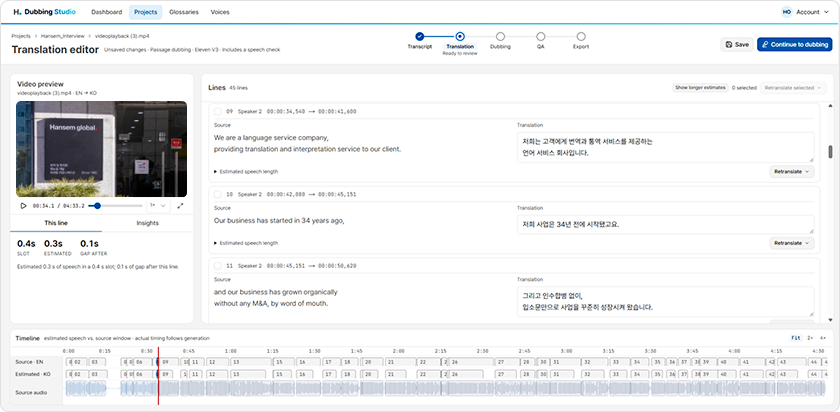
Hansem Dubbing Studio manages source analysis, localized voiceover scripts, speaker-specific voice generation, segment corrections, and final video output within one project workflow. It is designed to help editors locate a problem and revise only the affected section.
Confirm the source transcript and speakers
The team extracts the source transcript and speech segments from the uploaded video, then checks the wording, speaker assignment, and timestamps before translation. This reduces the risk of speech-recognition errors spreading into every target-language version.
Edit scripts and timing at the segment level
Editors can adjust translated scripts and segment durations for each speaker. When narration runs long, they can refine wording or timing while watching the relevant action on screen.
Regenerate only the affected voice segments
The workflow supports selective generation and regeneration, allowing teams to correct pronunciation or intonation without reproducing the entire voice track. Edited segments are reviewed alongside the audio before and after them.
Export and check the final dubbed video
Once the localized audio passes review, the team renders the final dubbed video and checks it as a complete audiovisual product, not merely as separate translated text and sound files.
Quality checkpoints from source to final video
| Production stage | Primary review criteria |
|---|---|
| Source transcript and speaker review | Speech accuracy, speaker identity, segment timestamps |
| Voiceover script adaptation | Meaning, spoken clarity, number and symbol readings |
| AI voice generation | Pronunciation, intonation, pace, pauses |
| Segment correction and regeneration | Targeted fixes and continuity with adjacent audio |
| Final audio and video QA | Scene synchronization, audio levels, terminology |
In an internal comparison on the same video, segments requiring regeneration fell from 58% with a commercial AI dubbing tool to 32% with Hansem Dubbing Studio, a reduction of 26 percentage points. Time to final approval dropped by 40%. These results come from a single internal test and are not a general performance guarantee.
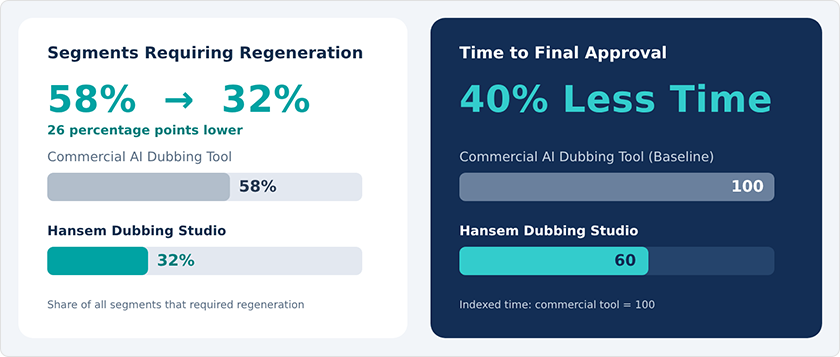
Internal comparison on the same video. Approval time is indexed to the commercial tool (100).
Optimization requires native-language specialists
A voice model cannot be considered equally production-ready in every language. Native-language reviewers need to listen to real video output, identify recurring issues in number readings, intonation, speaking speed, and technical terms, and feed those findings back into the production workflow.
Hansem Global has completed this optimization process for English-to-Korean and English-to-Japanese dubbing and uses those workflows in client projects. Work to expand optimization to more languages, including Vietnamese, Thai, and Chinese, is ongoing, and Hansem Global’s AI subtitling environment is being extended in the same way. Language availability and readiness should be confirmed for each project.
AI dubbing quality assurance checklist
A final dubbing review must involve listening to the audio while watching the video. Script-only proofreading cannot verify performance or synchronization.
- Are product names, acronyms, model numbers, measurements, and units pronounced correctly?
- Are pauses and speaking speed natural and intelligible?
- Do voice selection, formality, and tone remain consistent across speakers and scenes?
- Do regenerated segments blend naturally with surrounding audio?
- Does narration match scene changes and the order of on-screen actions?
- Are audio levels consistent and free of audible artifacts?
- Have all original warnings, conditions, and procedural details been preserved?
For technical training and product instruction, the localized script must also use the same terminology as the product manual and user interface. Fluency never justifies omitting a safety condition or procedural constraint.
What to ask an AI dubbing and video localization provider
When comparing AI dubbing services, ask about time to approved delivery rather than voice-generation speed alone. A reliable quote should clarify whether it includes voiceover script adaptation, pronunciation correction, segment regeneration, native-speaker listening review, final video QA, and the required level of synchronization.
Hansem Global combines terminology practices developed through technical documentation and software localization with Hansem Dubbing Studio to manage quality and schedules for Asian-language video dubbing. Projects run under ISO 27001-certified information security controls, which protects pre-release product videos and internal training content.
Planning to localize product, sales, or employee-training videos into Korean, Japanese, or other Asian languages? Contact us, and our team will review your content, target languages, and output requirements with you.