


Rebuilding an Industrial Equipment Manual Safety Section for North America: From Translation to Standards-Based Redesign
A Korean industrial equipment manufacturer needed the operator's manual for its electric forklift series to hold up in North America. Its 19-page Korean safety chapter, written as a flat list of 16 items, was rebuilt as a 25-page Section 1. Safety Rules under ANSI Z535.6 and IEC/IEEE 82079-1. Translation alone could not close that gap. A translator carries over what the source says and cannot supply what it never contained, and the source had no hazard severity levels, no reasoning behind its prohibitions, and none of the hazard topics North American regulations require. Those had to be written: signal word message panels, quantified limits such as OSHA's 25 ft (7.6 m) definition of an unattended truck, and topics drawn from OSHA 29 CFR 1910.178 and ANSI/ITSDF B56.1. The six pages the chapter gained are safety information the source never had.
Translating accurately does not make a manual safe. In North America and Europe, a safety section has to follow the hazard severity levels and message structure that the applicable standards define, and meeting that bar means rebuilding the document from its skeleton up.
Project Summary
A manual sold into North America operates on assumptions a domestic manual does not: published standards, federal regulations, and a product liability environment in which the manual itself becomes evidence. This project took the Korean-language safety chapter of an electric forklift operator’s manual (19 pages, 16 listed items) and produced Section 1. Safety Rules (25 pages, four-part structure) for the North American English edition. The work amounted to re-engineering. Structure, sentences, and illustrations were all redesigned against international standards.
| Client | Korean industrial equipment manufacturer |
|---|---|
| Product | Electric forklift series |
| Source document | Korean operator’s manual, “Safety Rules” chapter (19 pages, 16 listed items) |
| Deliverable | North American English manual, Section 1. Safety Rules (25 pages, four-part structure). Procedural content moved to Section 2. Operating Precautions |
| Applied guidance | ANSI Z535.6 (safety messages in product manuals), IEC/IEEE 82079-1 (principles for information for use) |
| Referenced standards and regulations | OSHA 29 CFR 1910.178 and 1910.333, ANSI/ITSDF B56.1, ISO 3691-1 |
| Workstreams | 1. Information structure 2. Signal words and message panels 3. Quantification and verification 4. North American hazard topics 5. Sentence style 6. Illustration |
Challenges
The Korean source did its job in the domestic market. Measured against North American requirements, three structural gaps appeared, and none of them could be closed by editing sentences. The document needed a new frame. This is not one manufacturer’s problem or one machine type’s problem. Forklifts, construction equipment, aerial work platforms, and agricultural machinery: manuals written in Korea tend to share the same structure.
- No hazard severity levels. Every precaution carried the same weight, so hazards that can kill an operator (tip-over, high voltage) sat alongside hazards that cause a twisted ankle (slipping while dismounting).
- Prohibitions with no reason and no consequence. “Never park on a slope” does not tell the operator why it is dangerous, what happens if they do it anyway, or what to do when level ground is not available.
- Missing information that North American regulations require. OSHA’s definition of an unattended truck, minimum clearance from energized power lines, and personnel platform requirements are not part of Korean manual convention.
Our Solutions
Six workstreams moved the safety information into the North American standards framework.
1. From 16 listed items to a four-part hazard structure
The Korean chapter mixed information types on a single level. Daily inspection (operator behavior), tip-over (physical hazard), and side shift (operating procedure) all appeared as sibling entries in a list of 16. Following the findability and information-type principles in IEC/IEEE 82079-1, the English edition was rebuilt as four parts.
- 1 Safety alert symbols and signal words. Definitions of the alert symbol and the signal words. New.
- 2 General safety rules. Operator qualification, daily inspection, mounting and dismounting, parking.
- 3 Operating hazards. High voltage, tip-over, pedestrians, mast, power lines, and hydraulics, organized by hazard type.
- 4 Safety decals. Decal locations, descriptions, and maintenance requirements. New.
Procedural content that answers “how do I do this work,” such as ramp travel and side shift operation, moved to Section 2. Operating Precautions. Keeping rules and procedures in separate sections is the information-type separation that 82079-1 calls for. The safety chapter grew from 19 pages to 25, and the six added pages are hazard information that had been missing.
2. ANSI Z535.6 signal words and three-part message panels
The English edition opens its first body page with signal word definitions. WARNING (death or serious injury), CAUTION (minor or moderate injury), and NOTICE (property damage) are declared as ANSI Z535.6 defines them. Section 1 alone carries 21 WARNING, 2 CAUTION, and 2 NOTICE panels. Each panel follows a three-part structure: the hazard, the consequence of ignoring it, and how to avoid it. Parking is the clearest example.
| Before: Korean source | After: North American English |
|---|---|
| 절대 경사면에 주차하지 마십시오. (“Never park on a slope.”) One prohibition. No reason, no consequence, no alternative. No severity level. |
WARNING: Parking on a slope “Parking on an incline can cause the truck to roll, resulting in collision, tip-over, or crushing of personnel. Do not park the truck on a ramp, slope, or inclined surface. If parking on a slope is unavoidable, chock the drive wheels in addition to applying the parking brake.” Hazard (rolling), consequence (collision, tip-over, crushing), and avoidance (do not park), plus what to do when there is no alternative (chock the wheels). |
Pedestrian safety was strengthened the same way. The Korean instruction to watch for people even while the warning lamp is operating became a warning with reasoning behind it: pedestrians may not see or hear the truck, struck-by incidents can be fatal, and warning devices alone are not enough.
3. Qualitative statements converted into verifiable numbers
- Definition of unattended. Added the OSHA-based quantitative definition: a truck is unattended when the operator is more than 25 ft (7.6 m) away or the truck is out of direct view.
- Clearance from overhead power lines. Added a minimum approach distance table by voltage, based on OSHA 29 CFR 1910.333(c)(3), starting at 10 ft (3.05 m) for lines up to 50 kV. Not present in the Korean edition.
- Dual units. ft (m) and °F (°C) throughout, so US sites and Canadian or other international users read the same figure.
- Personnel lifting. “Use special equipment” was replaced with the requirement to use an approved work platform meeting ANSI/ITSDF B56.1.
Verification also caught an error in the source. The Korean edition cited ISO 3961 as the basis for the operator presence sensing system, but ISO 3961 is a test standard for hydraulic hose. The English edition cites ISO 3691-1, the industrial truck safety standard. A single wrong standard citation can undermine the credibility of an entire technical document in an audit or a courtroom, which is why verifying cited standards is a step in the localization process.
4. Hazard topics the North American market requires
IEC/IEEE 82079-1 requires completeness in information for use. Working from the hazard assessment, the following topics were written for the English Section 1 and had no counterpart in the Korean source.
- High voltage and lithium battery hazards. Orange high-voltage cable identification, prohibition on contact and servicing, and a qualified-personnel-only rule.
- Power line contact response. Stay in the seat, step potential hazard, and a step-by-step evacuation procedure with feet together if the truck catches fire.
- Prohibition on puncturing, welding, or heating the nitrogen-charged vessel, plus the disposal procedure.
- Cab tilt. No work under the cab unless the tilt lock is engaged.
- Hydraulic hot surface burns and safety decal maintenance. Replace missing or unreadable decals by part number before operating.
The safety decal part in particular became a maintenance requirement rather than a location diagram, carrying a WARNING against operating with missing or illegible decals along with replacement part ordering information.
5. Sentence style standardized
The Korean safety chapter had no writing convention for safety messages. Explanatory prose about why accidents happen sat on the same level as instructions about what to do, and there were no severity markers. The tip-over topic spends six sentences on the mechanics of sideways and lengthwise tip-over before any action appears. The information an operator needs during an emergency sits behind an essay.
Vocabulary was also distant from the language used on the floor. The Korean source leans on Sino-Korean compounds for tip-over, sideways, lengthwise, overload, and hard braking. Safety information is read under time pressure, so vocabulary that has to be decoded is itself a hazard.
The English edition applies the ANSI Z535.6 message format together with plain language principles. Message panels lead with the hazard as a noun phrase, then the consequence, then the avoidance. Body instructions use active-voice imperatives with one action per sentence, and anything order-dependent becomes a numbered list. Vocabulary settled on everyday terms such as tip-over, sideways, and lengthwise, and the machine is called a truck throughout. The tip-over topic now drops the mechanics essay and gives four numbered actions under the heading “If the truck begins to tip over.”
6. Illustrations rebuilt for international readers
Visual material was redrawn from scratch. An illustration carries information rather than decorating the page, so what the reader has to watch out for should be visible in the drawing itself while the drawing stays simple. On that basis the cartoon-style artwork in the Korean source was set aside and replaced with the safety illustration conventions used internationally.
Figures were redrawn without facial expressions or exaggerated poses, so that gender, ethnicity, and age are not identifiable. Each illustration was narrowed to one piece of information. The personal protective equipment item, which had crowded six pieces of gear into a single circle, became one figure putting equipment on. Where a drawing carried too little information, context was added instead. The prohibition on parking near emergency equipment had shown a truck and a fire extinguisher side by side; the new drawing places the truck in an aisle with wall-mounted equipment behind it, so the blocked access explains the prohibition on its own.
The visual vocabulary was unified as well. The pedestrian topic had three scenes drawn at different viewpoints and scales, and all three now use one convention: the operator’s sight lines and the visible field. Mounting and dismounting had used an arrow pointing at the step, and now shows the three-point contact posture, with the prohibition on jumping moved into a CAUTION panel. Drawings carry the correct action and safety messages carry the prohibitions.
The comparisons below show the Korean source pages as they were published, alongside the North American English pages produced from them.
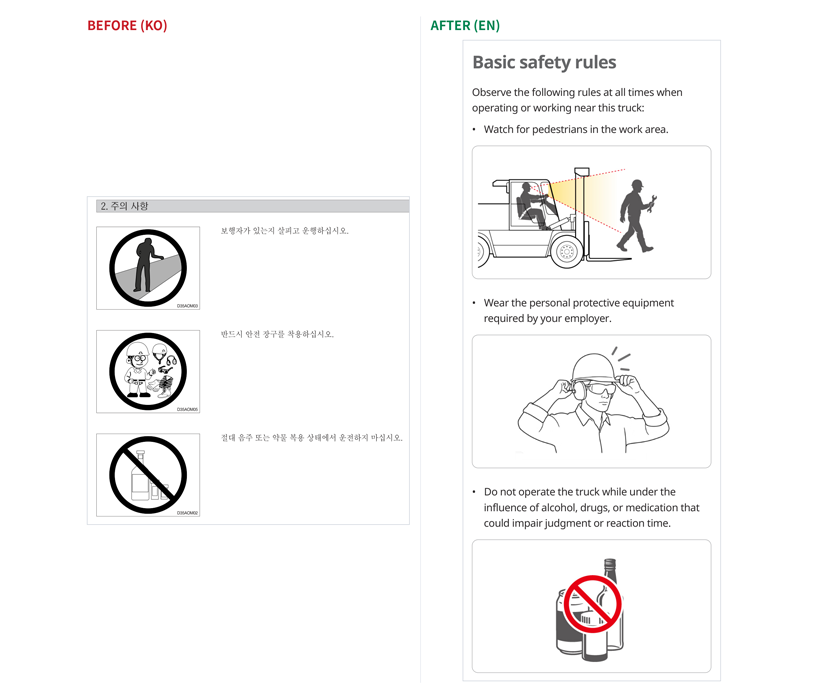
Comparison 1. General safety precautions. Korean source (left) and North American English (right). Cartoon pictograms that borrowed the form of standard safety symbols were redrawn in a universal design style.
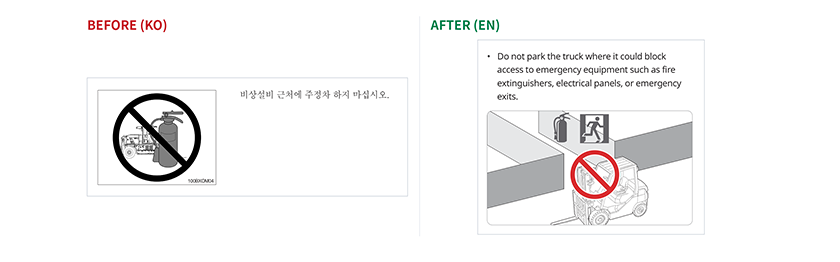
Comparison 2. Parking near emergency equipment. Korean source (left) and North American English (right). The illustration was redrawn as a situation and the instruction text was expanded.
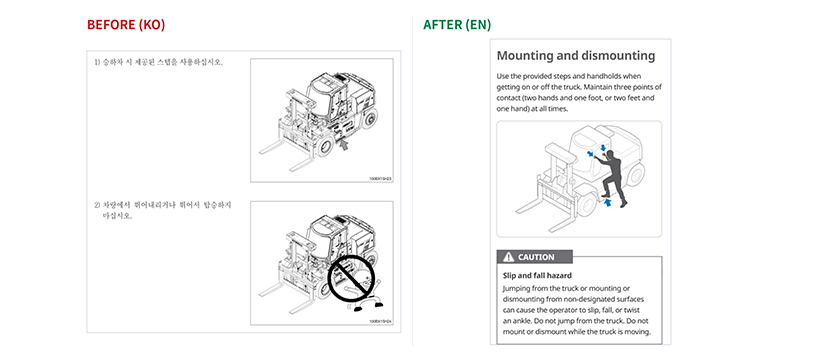
Comparison 3. Mounting and dismounting. Korean source (left) and North American English (right). The prohibition on jumping moved to a CAUTION panel, three-point contact was added, and the illustration was redrawn to show the action.
Outcome
Comparing the Korean safety chapter with the North American Safety Rules section item by item shows what localization actually changed.
| Item | Before: Korean safety chapter | After: English Safety Rules |
|---|---|---|
| Structure | Single chapter, 16 listed items | Four parts (1.1 to 1.4), procedures moved to Section 2 |
| Length | 19 pages | 25 pages, plus 15 pages of Operating Precautions |
| Severity levels | None | 21 WARNING / 2 CAUTION / 2 NOTICE |
| Message structure | Single-sentence instructions | Hazard, consequence, and avoidance panels |
| Quantified information | Mostly qualitative | 25 ft (7.6 m) definition, power line clearance table, dual units |
| Illustrations | Domestic-market artwork | Rebuilt to international safety illustration conventions |
Localization succeeds or fails on whether the target market’s standards become the frame for the document. On this project the format of safety messages came from ANSI Z535.6, the ordering and completeness of information came from IEC/IEEE 82079-1, and the required content came from OSHA and ANSI/ITSDF B56.1. The result is a manual that supervisors and operators in North America can read against the same rules they are held to.
Frequently asked questions
- Can a native-speaking translator handle the target market on their own? A native speaker makes sentences read naturally. No translator invents information that is not in the source. If the Korean source has no severity levels, the translation has none. If an OSHA-required topic is missing, it stays missing. A North American safety section has to follow the signal word system and message structure in ANSI Z535.6, so the first decision is which standard frames the document rather than which words to choose. On this project the safety chapter grew from 19 pages to 25, and those six pages hold information the source never had.
- Why does the safety section matter more than other chapters? In North America the manual is treated as part of the product. After an incident, whether the warning was adequate becomes a question in product liability litigation, and the manual is the evidence. Whether the hazard was disclosed, at what severity, and whether an avoidance method was given all have to be visible in the document. The safety section is where a manual meets regulation directly, so the bar is higher than elsewhere.
- Beyond language, what has to change when a manual is localized? Conventions come first. Units, date and time formats, decimal and thousands separators, and the way temperature, pressure, and weight are expressed differ by market. Safety signs and symbols have to move to the system the target market uses, and the colors and shapes assigned to signal words differ between the ANSI Z535 family and the ISO 3864 family. Regional regulation comes next. North America adds what OSHA and the applicable equipment standards require, while Europe adds member state language requirements and its own content items such as noise and vibration values. Text inside illustrations, decal artwork, and part naming conventions all belong on the review list.
About Hansem Global
Hansem Global has developed technical documentation and localized it into more than 100 languages since 1990. The company holds ISO 17100, ISO 18587, and ISO 27001 certification, along with ISO 9001 scoped to the manual development process itself. Hansem Global ranked 37th in the 2026 CSA Research Verified 100, an annual ranking of the world’s leading language and global content solutions providers.