


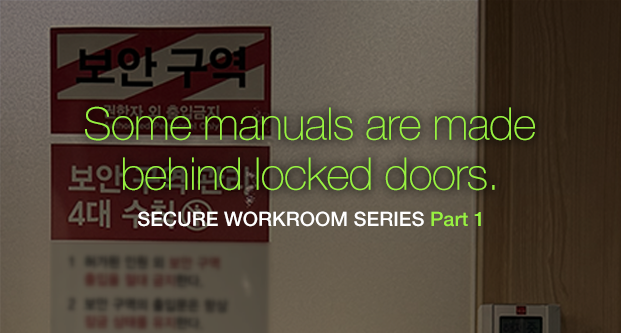
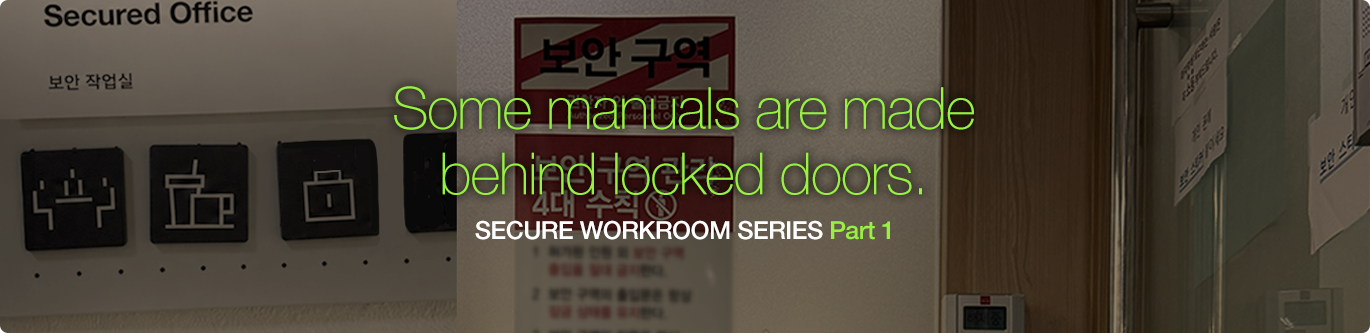
Monday, 9:00 a.m. A technical writer arrives at the office, but she does not sit down at her own desk. She taps her badge twice, checks that the security sticker still covers her phone’s camera lens, and opens the door to a room the internet does not reach. Inside, the manual she will write today describes a product whose new capabilities have not yet been shown to the world.
We call this room the secure work room: a room the internet does not reach, where USB ports are sealed and camera lenses are covered — an isolated space in which the channels information uses to escape are closed off from the start.
Some Information Is an Asset in Itself
A single design drawing of an unreleased product. One page of a clinical trial report. One line of a defense component specification. One frame of a next-generation device’s assembly structure.
Material like this can leak in seconds. The consequences are long and heavy: years of technical lead, hundreds of millions invested in R&D, a launch timeline tuned to reach the market first — any of it can come undone in a moment.
That is why companies in security-sensitive industries treat information the way they treat physical assets. Who handles it, where, and under what conditions — every point of contact is controlled.
The trouble is that this asset does not stop at a single page or drawing. For a product to reach the market, a manual has to be created — and for a global launch, in many languages at once. While that manual is being built, the material passes through the hands of technical writers, DTP specialists, QA reviewers, and localization managers in turn. Somewhere along that chain, a blind spot opens that no NDA can close.
“Information is most at risk at the very moment the most people are handling it.”
What an NDA Alone Cannot Protect
Every secure project has an NDA, of course. Once it is signed, everyone is bound.
But in practice, information rarely leaks on purpose. A laptop screen glanced at over coffee on the commute. A file emailed home to finish after hours. A printout left behind in a conference room. A photo of a desk posted, without a second thought, to social media. An NDA cannot prevent these accidents. A signature binds behavior after the fact; it does nothing to stop the moment of carelessness before it happens.
And yet the information gets out. Once it is gone, it does not come back. Deliberate theft is rarer, but far more damaging. A determined thief is hard to stop — but even a determined thief has to stop when there is no channel to carry the information out.
So some companies began to ask for something beyond an NDA. Not a signature, but an environment.
Enter the Locked Room
What does it mean to control the environment?
It means closing off, from the very beginning, every channel information could travel through. A room the internet does not reach. Computers with their USB ports sealed. Phones with camera lenses covered so no picture can be taken. A door only pre-approved people can open. Cameras running 24 hours a day.
Under these conditions, a person is finally placed in an environment where a mistake is impossible. There is no way to show the material to anyone, even if you wanted to; no channel to carry it home, even if you tried; and no access to the very platforms where a careless post might appear.
It is an uncomfortable environment. Some have called it a prison. One Hansem Global practitioner who reports to this room every day put it this way:
“Honestly, it is stifling. But because of this room, I know I cannot make a mistake. That is the greater reassurance.”
The Companies That Can Build This Room — and the Ones That Cannot
Building a locked room is harder than it looks. It requires dedicated physical space, and dedicated computers, servers, and software to go inside it. These have to be operated separately from everyday tools, and inspected, replaced, and updated on a regular schedule.
The harder part is the people. Someone working in a locked room has to produce finished work in an environment cut off from the internet — finding precise terminology without a search engine, writing to industry standards without external references, handling 50 languages at once without cloud collaboration tools. This is not a question of tools. It is a question of expertise.
That is why, with a secure work room, having one matters less than the time spent operating one. You can buy the space. You cannot buy the operational know-how.
What This Series Covers
Hansem Global has built manuals and multilingual content for global manufacturers for 35 years. Many of those projects could not show a single line to the market before launch. So in 2012 we built our first secure work room, learned how to run it, and trained the people who work inside it. Fourteen years on, not a single leak has occurred.
This series is about that room. We will not show many photographs of it — there is too much that cannot be shown. But why the room has to exist, how people work inside it, and why that work is not something just anyone can do — we will take these up, one part at a time.
The next part covers the conditions this locked room has to meet: what gets shut out, and what has to be in place.
Some work can only be made safely behind a locked door.
Hansem Global Secure Work Room Series · Part 1
📌 SERIES GUIDE
This article is Part 1 of Hansem Global’s Secure Work Room Series. The series continues as follows:
Part 1 · Why Some Manuals Are Made Behind Locked Doors (current article)
Part 2 · What a Secure Work Room Is Made Of (Environment and Infrastructure)
Part 3 · A Lock Doesn’t Lock Itself (Security Awareness, the Real Infrastructure)
Part 4 · Writing Manuals in a Room With No Internet (A Day in the Life of a Technical Writer)
Part 5 · Managing 50 Languages Inside a Locked Room (A Day in the Life of a Localization PM)
Part 6 · Making Marketing Content in a Sealed Room With No Internet (A Day in the Life of a Retail Graphic Designer)
Part 7 · 14 Years, Zero Breaches: Why It Was Possible.