


Blog

What Data Work Does Physical AI Require?
Physical AI depends on more than robots, sensors, and advanced AI models. Real-world and synthetic robot experiences must be structured, annotated, connected to human instructions, validated, and turned into reliable training and evaluation data. This article looks at the data work behind that process and where multilingual and human-in-the-loop operations fit in. Physical AI is […]
Manual Standardization for Product Variants
When a new product ships, variants follow. Same product family, same primary users, but a different screen layout, a moved button, a feature that appears on one model and not the next. Product documentation follows the same cycle. Early on, the team copies the last manual and edits what changed. That holds up for a […]
What ISO 10218:2025 Now Requires in Your Robot Manual
A robot manufacturer’s manual is, before it is a user guide, the first document a certification authority examines. As Part 1 of this series established, the manual and its labeling are themselves the object of certification review, and robot safety regulations specify exactly what must appear — and in what form — in the manual, […]
Manuals Under Regulatory Scrutiny (Part 1): The Overlooked Fact
Most manufacturers treat the product manual as a low-stakes user document. In reality, the manual, the instructions for use (IFU), and the labeling are among the first things a regulator examines — and a single omission or a mismatch between language versions can stall certification, hold up market entry, or trigger a recall. This article […]
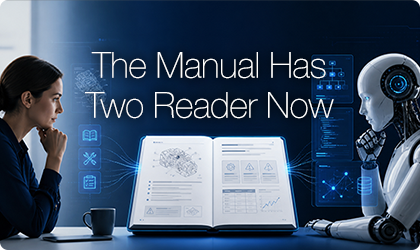
Technical Writers in the Age of Robot Coexistence
Google DeepMind has published a series of reports worth flagging for anyone whose work touches technical documentation: What these reports point to, taken together, is a quiet shift in how text functions. Natural-language manuals — text data — are starting to look less like an aid for human comprehension alone, and more like a “blueprint […]

Inside MODEX 2026: AI on the Floor
At MODEX 2026 in Atlanta, AI didn’t just show up — it ran the floor. Watching it work raised a quieter question: when warehouse hazards stop being visible, where does technical documentation stand? These are notes from the floor — and the case for what documentation has to become. On the Floor Walking into the […]
Multilingual Manuals Are Not “Translation Work.” They Are Release Operations.
In global launches, multilingual manuals are often treated as a downstream deliverable: translate the English, format it, and ship it. In reality, manuals behave like a release system. Specs change late. UI strings finalize at the last minute. Country-specific compliance statements must be correct. Layout breaks differently by language. One small miss can propagate across […]

From IEC to ANSI: 6 Global Standards That Make or Break Your User Manuals
User manuals that meet global standards—not just expectations. No matter how advanced your product is, a poorly written or non-compliant user manual can create serious problems—from safety incidents and customer confusion to denied certifications or lawsuits. For electronics, machinery, robotics, and other complex systems, manuals are no longer just support documents—they’re your first line of […]